Friday, March 1, 2013

Thoreau's little house in the woods

Earlier this week I was down in Massachusetts and on Monday after visiting some old friends in Concord, stopped by Walden Woods to see if we could find Henry David Thoreau's little house.  It no longer exists but there's a replica there of the one-room structure in which he lived from July 4, 1845 to September 6, 1847.

The original building stood on a slope overlooking Walden Pond about one-half mile from here [in the photo].  It was possible to create an accurate reproduction of Thoreau's home because he described it in such detail in Walden, the book he later wrote about his two-year-long experiment.  Thoreau built most of the home with his own hands.


The 10' X 15' cottage, as seen from the back


Someone had been there before us.  Footprints going in,
circling the house, coming back out


Walk up and peek into the window at the side
and you see:

a desk and 3 chairs


This is the front of the house.
Looking in at the other side window, you see:

Thoreau's desk, on top of which sits what looks like
a Visitor Book where guests can sign their names.  


To the left, Thoreau's fireplace, stove and woodpile;
underneath the opposite window, a single bed


Cost of Materials for Thoreau's House (from Walden)


                                            Boards                                       $8.03 1/2            Mostly shanty boards
                                            Refuse shingles for 
                                            roof and sides                            4.00
                                            Laths                                              1.25
                                            Two second-hand windows
                                            with glass                                     2.43
                                            One thousand old brick          4.00
                                            Two casks of lime                      2.40                  That was high.
                                            Hair                                                 0.31               More than I needed.
                                            Mantle-tree iron                        0.15
                                            Nails                                               3.90
                                            Hinge and screws                      0.14
                                            Latch                                              0.10
                                            Chalk                                              0.01
                                            Transportation                           1.40                  I carried a good part on my back.
    
                                                                                               $28.12  1/2


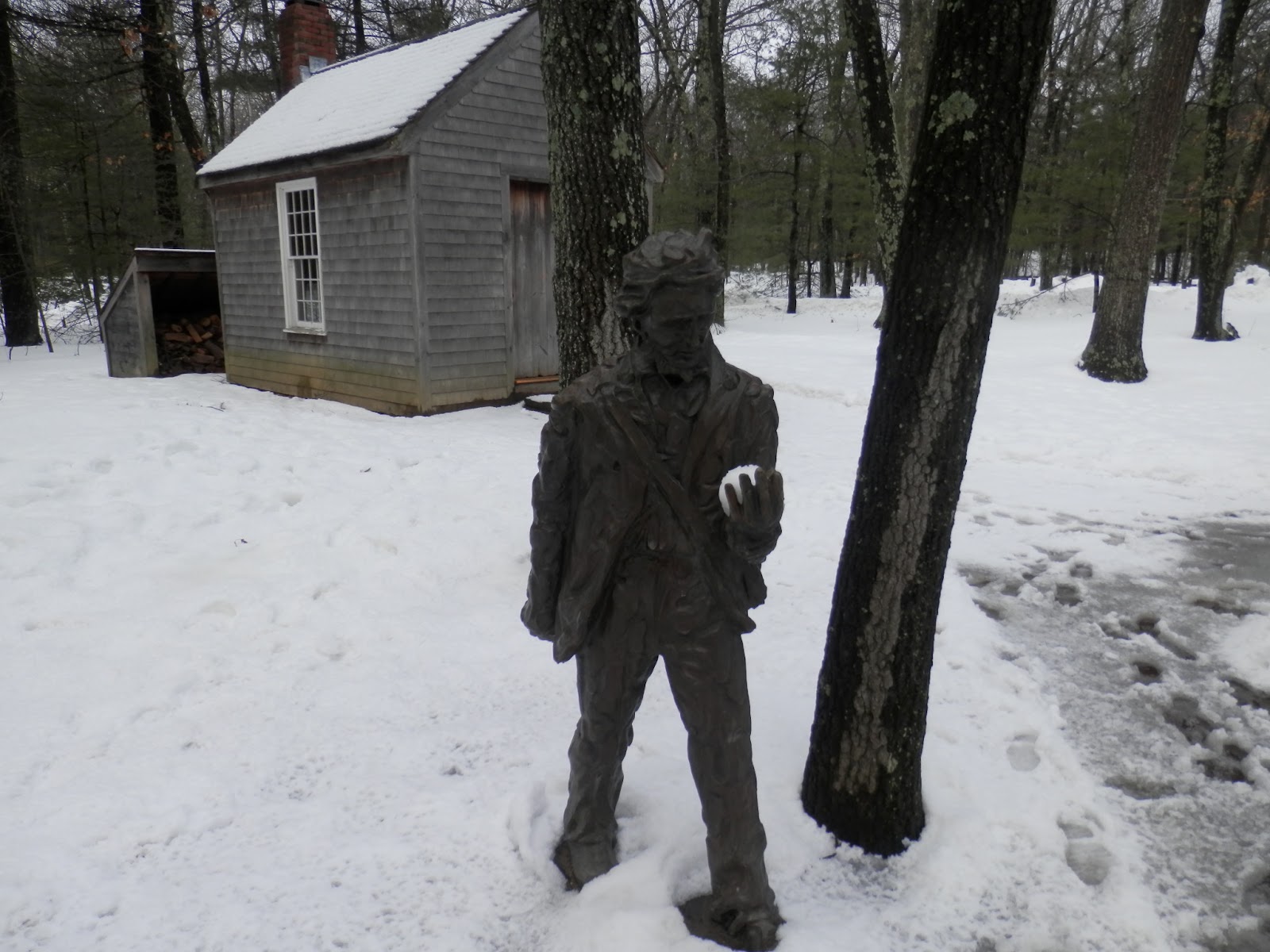
Sculpture nearby.

While at Walden, Thoreau chopped wood, cleared land, made bread, grew
vegetables (2 acres of beans), did repairs, and of course, read books and wrote.
He often had visitors (hence, the 2 extra chairs), and regularly trekked into town for news.


I imagine Thoreau walking these woods,
spring, summer, autumn, winter . . .


"Soon the ice will melt, and the blackbirds sing ..." 

listening for the birds,
contemplating snow

Thoreau claimed he never found a companion that was so companionable as solitude.  Who of us has not at one time or another wanted to get away somewhere, to some island or seashore or cabin in the woods, to be alone to think or write or meditate sans distraction?   And yet he was distracted (by the sound of the passing trains, for example, which irritated him; by visitors, by inclement weather). 

 "Simplicity, simplicity, simplicity!"  A dead writer's temporary work and living space reproduced repositioned, and preserved for generations to come.  Honoring the writer, remembering his writings. Which most captivates here--the writer, his former dwelling/experience of living alone in these woods, or his words? 

My two most remembered Thoreau quotes:

          If a man does not keep pace with his companions, perhaps it is because
             he hears a different drummer.   Let him step to the music which he hears, 
          however measured or far away.

          It is not what you look at that matters;
          it's what you see. 

My favorite part of these grounds is Walden Pond, one of the absolute best places for swimming in the area [IMHO].  Walks in the woods in the winter, anywhere though, always a pleasure, with or without encountering a reconstructed famous writer's former house.  Unlike Thoreau, though, I love the sound of trains.  And you hear them all the time here, still chugging along the tracks - train whistles and bird tweets and silence: life in these Walden woods.


Monday, February 18, 2013

Beholders' Eyes

_________________________________________

VALENTINE FOR ERNEST MANN

You can't order a poem like you order a taco.
Walk up to the counter, say, "I'll take two"
and expect it to be handed back to you
on a shiny plate.

Still, I like your spirit.
Anyone who says, "Here's my address,
write me a poem," deserves something in reply.
So I'll tell a secret instead:
poems hide. In the bottoms of our shoes,
they are sleeping. They are the shadows
drifting across our ceilings the moment
before we wake up. What we have to do
is live in a way that lets us find them.

Once I knew a man who gave his wife
two skunks for a valentine.
He couldn't understand why she was crying.
"I thought they had such beautiful eyes."
And he was serious. He was a serious man
who lived in a serious way. Nothing was ugly
just because the world said so. He really
liked those skunks. So, he re-invented them
as valentines and they became beautiful.
At least, to him. And the poems that had been hiding
in the eyes of skunks for centuries
crawled out and curled up at his feet.

Maybe if we re-invent whatever our lives give us
we find poems. Check your garage, the odd sock
in your drawer, the person you almost like, but not quite.
And let me know.

~ ~ Naomi Shihab Nye

Red Suitcase, Boa Editions, Ltd., 1994
_____________________________________

Naomi Shihab Nye, winner of the 13th Annual Robert Creeley Award, reads on
March 6, 2013 at 7:30 PM, at Acton-Boxborough Regional High School auditorium,
36 Charter Road, Acton, Massachusetts.

Saturday, February 16, 2013

Trekking with the Sketchers

The "Before" Scribble

this is a drawing I made 2-3 yrs ago
experimenting with an online Paint program
a fictional character invented for a story
that never got written . . .
time to get serious & learn
how to make a proper nose
(not just a hook with dot)
& remember to include the ears next time -
color inside the lines.

so they offered this little course
8 minutes' walk from here
10 weeks for $25
"Drawing for Beginners"
      there are 14 of us
we meet Monday nights for 2 hours
bring our big sketch pads & #2B & #4B pencils
first task was to draw Picasso's Stravinsky upside down
our homework this week is to
sketch electrical outlets & objects with angled corners & household appliances

fascinating so far,
the left-brain/right-brain thing -
consider the above drawing an old, hasty, "Before" rendition
to be compared, at the end of the course,
with a hopefully more realistic version.

hard work, lots of mistakes but
who knew it could be so addictive
&
fun

Thursday, February 14, 2013

Obama's early poems

I was checking Ebay this morning for a particular poetry book and happened upon an auction for a 1981 Occidental College publication that contains two of then-19-year-old Barack Obama's poems.

Here are the two poems, "Pop" and "Underground", which renowned literary scholar Harold Bloom, "probably the most celebrated literary critic in the U.S." analyzed back in 2007.

Bidding starts at $500.

Thursday, February 7, 2013

Winter fun

                      
                       At the Parc des Chenaux the other day, some boys from the nearby elementary school,
                       out playing hockey with their phys. ed. instructor, Eric.   Video & photos taken with
                       my new Olympus pocket camera.  A freezing-cold day, but the kids didn't seem to mind. 

                       Today it's -26 C (about -11 F) without the wind  chill factored in.   And a brilliant blue
                       sky overhead again.


                         The previous night there were about 16 skaters out skating here, the very
                         young to the very old.   In spring the ducks  come back to claim the pond.                                 

   Very slippery that morning.  Quite a few tumbles.


Thursday, January 31, 2013

Priorities


                                                                                1%  -  Food
                                                                                2%  -  Transportation
                                                                                2%  -  Labor
                                                                                3%  -  Science
                                                                                3%  -  Energy & Environment
                                                                                4%  -  International Affairs
                                                                                5%  -  Health
                                                                                5%  -  Veterans' Benefits
                                                                                6%  -  Housing & Comminity
                                                                                6%  -  Government
                                                                                6%  -  Education
 
                                                                               57% - Military

Thursday, January 10, 2013

Being like a Cloud, Embracing the Tiger


The performer is Gao Jiamin.  According to Kungfu Magazine (July 2000 issue) she was born in Fuzhou City, Fujian Province, China June 26, 1966. At the time of the article she had "won 32 gold medals, a record that has never been achieved by any other competitor". She is (or was) a chief instructor at "US Wushu Center" in Portland, OR.

T'ai Chi is like a slow, beautiful dance where your hands can wave like a cloud, lift water, repulse a monkey, part a wild horse's mane, grasp a sparrow's tail, or embrace a tiger --all names of actual T'ai Chi positions.  There are 108 of them.  I have so far managed to master only the first 16.  The forms themselves are not difficult - it's remembering the entire sequence that's challenging.  It looks so easy, but each body placement and movement is precisely intended.  Our instructor's teacher spent six months perfecting a single form.  This no longer seems a strange thing to me. 

Is it True what they say, about the energy?

On a trip to Buffalo last year there sat next to me on the bus a young ex-professional hockey  player traveling from Canada to the U.S. to visit his girlfriend.  He'd been forced to reconsider his career options after a bout of devastating injuries which required immediate surgery, leaving him with an unexpected, long-term disability.  He took up yoga, one might say with a vengeance, determined to "fix" himself.  One year later his doctors were amazed.  He was now stronger and in better health than he'd been before the accident, and no longer limited in what he could do.  It was a wake-up call for him, he told me, which changed his life. 

He told me more about yoga. I told him what little I know about T'ai Chi.  We've both, apparently, at one time or another, experienced the "prana", or universal energy they all talk about.  I used to think this was all just "New Age" talk, till I actually experienced it.  I can't speak for others but since then, I find I don't get tired, rarely get sick (except a minor cold), and have none of the aches and pains and maladies most people my age seem to routinely suffer from, that require medication.  Unlike gulping down a Red Bull energy drink or caffeinated coffee where you're temporarily jolted into "reboot", this energy is a quieter, more sustained infusion. It lasts longer.  And you can access it  by practicing yoga, chi gong and t'ai chi.

Words, too, energize, heal.

To each his own.  One person's passionate pursuit is another's yawnful non-interest.  But a person's single, scratched-out line in a penciled scribbling contemptuously discarded, unexpectedly unnearthed decades later,  random words or a single line in a book--could be the impetus to change a random reader/hearer's entire life. This, too, is a kind of  energy.  It happens.  What is it, this invisible 'life' force they talk about, that no one can see, much less adequately define?  History shows us that a single word,  idea, or image, can effect monumental changes.  Hidden energies manifest in language and the creative impulse, that starts the ball rolling, whereby a connection is made and one's reality suddenly changes.  Behind everything, Consciousness.

The Difference Between Doing it and Being it

The quotation (from the person who posted the video to YouTube) describes it as a "performance".  As did I, above.  Performance can be perfected, such that it becomes as natural as say, breathing.  You don't even think about it, you just begin, until you end.  Sometimes during the doing, however, you transcend the fact of doing, and enter a place beyond the self-in-the-act-of-doing and become pure [what's the word here? Rhythm? Energy? Being?] It's not Automatonville from force of habit, nor out-of-body, -  I can list a dozen things it's not.  It's less loss of consciousness of self than total,  joyful immersion into what one might call the "dance of Life."  Even those who can't dance can see it. 

Tuesday, January 8, 2013

Peace Prize Prez - "For War"?


inadvertent subliminal?

"The polices adopted by the Obama administration just over the last couple of years leave no doubt that they are accelerating, not winding down, the war apparatus that has been relentlessly strengthened over the last decade. In the name of the War on Terror, the current president has:

diluted decades-old Miranda warnings;
codified a new scheme of indefinite detention on US soil;
plotted to relocate Guantanamo to Illinois;
increased secrecy, repression and release-restrictions at the camp;
minted a new theory of presidential assassination powers even for US citizens;
renewed the Bush/Cheney warrantless eavesdropping framework for another five years,
as well as the Patriot Act, without a single reform;
and just signed into law all new restrictions on the release of indefinitely held detainees.

"... one can say for certain is that there is zero reason for US officials to want an end to the war on terror, and numerous and significant reasons why they would want it to continue. . .

"If you were a US leader, or an official of the National Security State, or a beneficiary of the private military and surveillance industries, why would you possibly want the war on terror to end? That would be the worst thing that could happen. It's that war that generates limitless power, impenetrable secrecy, an unquestioning citizenry, and massive profit.

"Just this week, a federal judge ruled that the Obama administration need not respond to the New York Times and the ACLU's mere request to disclose the government's legal rationale for why the President believes he can target US citizens for assassination without due process. Even while recognizing how perverse her own ruling was - 'The Alice-in-Wonderland nature of this pronouncement is not lost on me' and it imposes 'a veritable Catch-22' - the federal judge nonetheless explained that federal courts have constructed such a protective shield around the US government in the name of terrorism that it amounts to an unfettered license to violate even the most basic rights: 'I can find no way around the thicket of laws and precedents that effectively allow the executive branch of our government to proclaim as perfectly lawful certain actions that seem on their face incompatible with our Constitution and laws while keeping the reasons for their conclusion a secret' (emphasis added)."

"Why would anyone in the US government or its owners have any interest in putting an end to this sham bonanza of power and profit called 'the war on terror'?  . . .

" . . . the US government is even entertaining putting an end to any of this is a pipe dream, and the belief that they even want to is fantasy. They're preparing for more endless war; their actions are fueling that war; and they continue to reap untold benefits from its continuation. Only outside compulsion, from citizens, can make an end to all of this possible."

[Source]  Glenn Greenwald: "The war on terror - by design - can never end".


Tuesday, January 1, 2013

Leaving one's island


Written and sung by Daniel Lavoie

We leave
     we come back
           we go
                  we stay
                       we're all little islands,
                              anchored,          
                                       afloat.
            

J'ai quitté mon île

J'ai quitté mon île quand on m'a envoyée
L'ai quittée tranquille sans chanter ou pleurer
Un beau matin vous verrez les voiles de mon voilier
Prendre le large vers les îles

J'ai quitté mon arbre on est venu le couper
J'ai trouvé les sables rien n'y était plus semé
Un beau matin vous verrez les voiles de mon voilier
Prendre le large vers les îles

J'ai quitté ma terre on a voulu l'ach'ter
On n'achète pas la terre
La terre c'est moé pis toé
Un beau matin vous verrez les flammes de ma fusée
Prendre le ciel vers mon île

{Musique}

Un beau matin vous verrez les voiles de mon voilier
Prendre le large vers les îles
J'ai quitté mon île {2x}


A beautiful song, in a beautiful language, for a snowy, sunny first day of the year.

Monday, December 31, 2012

Goodbye 2012, Hello new year

Photo by Luis L. Tijerina - Taken in Burlington, Vermont last night

 
What December Said to January

Let the record
show I did
not go willingly.

Nor am I impressed
by the ruse you
call “The First,”
which you use
to hide the fact
I passed this way.

I am offended,
not ended.

Do not forget,
I have frozen ponds
and cast blood-red berries
to the ground; I have
blotted out the sun.

You have crocuses,
I’ll grant you that;
but I have summoned them;
the rest you leave for
spring to solve.

My advice to you?

Take pride in what you do
and never follow suit;
your days are numbered;
be true to them.

________________________________________

From Poems, Slightly Used, by William Michaelian.    I posted this same poem here in 2009 (with William's kind permission) and thought I'd include it again.

End of year thanks to the many fellow writers/poets/bloggers who've inspired, shared and generously given of their time, talent, and encouragement when approached by the Salamander for poems, photos or art work, or queries about poetry, translation or writing in general, some of whom have since become treasured friends.

HAPPY NEW YEAR ONE AND ALL!


Saturday, December 29, 2012

Receivings and Takings Away


Holiday Gifts Received:  

-a new camera. Yay.
-a pair of NukNuuk slippers, footware so comfortable another owner actually wrote an ode to them.
-a gigantic white, scented candle
-a tall glass vase crammed with apricots soaked in amaretto-liquor
-a yellow tablecloth with a red rooster motif
-microwavable teatowels
-a crate of imported Moroccan clementines
-lavender hand cream and lime-colored liquid hand soap
-green dangly earrings (from me to me)
-two poems,  by email, from a haiku poet acquaintance, out of the blue
-a hand-painted Christmas card
-a friend's recently published book
-our cat Nikki, in my lap, her final gesture of affection, touch of paw extended
  before the unexpected, unwanted--devastatingly difficult for us--Relinquishment
                  and
 -Consciousnesses,  too detailed and/or impossible to articulate

~ ~   ~ ~   ~ ~

Some photos I'd like to share:

Bike path, Burlington, VT, first snowfall, two days ago (photos by Luis L.Tijerina)
Lake Champlain waterfront, Burlington VT
Burlap again, a favorite remembered walkpath

my neighborhood (T-R, Quebec), yesterday

~ ~   ~ ~   ~ ~

Note:

she is not a footnote
some things take time to
talk about:
_______________________________________________________

BYE, NIKKI


"Nikita" a/k/a Nikki  2001-2012

Des bons souvenirs:


See ya, Nik.


_________________________________


It's not fair
I got to hold her one last time &
you didn't.
Our Nikki
here for years and then suddenly
not.


Thursday, December 20, 2012

The new normal


SPMCs ["simply persistent multiple contrails"]

Blue sky.
They scoot by.
Spray stays,
gridifies.

Bye bye 
blue sky.


Tuesday, December 18, 2012

The urge to respond

Vingt


This tragedy, that -
20 innocents murdered in a classroom in Connecticut
10 young girls blown to bits gathering firewood in Afghanistan,
this number colatterally damaged by drones last month,
that number killed in this or that war, today,
another veteran suicide (do the dates matter?)
Depending on the proximity
      calamity  / enormity,
its effect on you personally,
out pours the grief,
    tears,
          outrage/ stunned silence; the
words, they come Later - as
newspeople go media it
      photographers go photograph it
          bloggers go blog & twitterers go tweet it -

artists go paint it
      writers go write it,and
               poets go poem it:
Impact/ Reaction/ Expression/ Analysis/ Catharsis

I can't find words
this time. It's not working.
Word-working the fact or penning an emotion;
      draped in this format, seems
simply a comment,
trying hard to be other.

The urge to respond; Some have
with money / wreaths / care/
candles/ food baskets/ a teddy bear/
tears/ hugs/ call for action/ more security,
words & more words
or just plain numbed
thereness.

How does one paint silence?
Or word speechlessness?
   how do you convey a felt unpunched punch in the gut, you're left to
dig into the mind's Word-Bin and
all that comes out is
dumb-sounding
      numb-pounded
   (wholly inadequate)
wordcrumbed, scatterworded
af-fect (after the fact).

So compelling, that urge to respond - how ever
Because  you're alive, and can
(albeit remotely,
        ineffectively) ...
while they - those 20 small ones -

can't.

___________________

*Re:   the attempted black/red/white artwork - 20 birds ascending/ transcending/ out of the raw memory of bloodbath/ darkness. I am not an artist but this image of the children as small birds flying together kept coming to me. Despite the spatial dominance/symbolism of the jagged red streaks, when I re-look at this picture, I'm taken past the red and see only those wings, 20 little white birds in a night sky, almost like stars, forever twinkling.  It is how I would like to remember them- together, at peace, happy, free.  


Wednesday, December 12, 2012

Thank you, Ravi


1920-1912

Every time I hear that sitar-
a flood of memories.


"The music that I have learned and want to give is like worshipping God. 
It's absolutely like a prayer."

                                                                                       ~ ~ Ravi Shankar, on Playing the Sitar


Monday, December 10, 2012

Letting their Voices Be Heard

Today is Human Rights Day worldwide.  If anyone's interested, here are two brave persons, continuing to speak out.   


 "They shot him nine times.
Losing a child breaks your heart in pieces.
It can't be compared to anything.
We gather strength from nowhere,
and start over.
My dream is to find justice."

Doris Berrio is the founder of the "League of Displaced Women", a group of women denouncing human rights violations and supporting women's issues.  She was forced to flee her home village in the region of Uraba in Colombia in 1997. Her husband received death threats from armed groups who had moved into the area. She escaped with her two young sons to the city of Cartagena, only to have her youngest son then murdered in retaliation for her efforts to fight back.


Blind self-taught legal activist Chen Guangcheng speaks directly to China's new leader Xi Jinping about human rights and rule of law violations, as well as religious persecution.  He names particular prisoners of conscience and asks for their release, one of whom is Nobel Peace Price Laureate Liu Xiaobo*.

(*For 26 months, Xiabo's wife Liu Xia has been cut off from the world outside her apartment in Beijing – prevented from receiving guests, making phone calls or using the Internet. She’s been charged with no crime. She is being punished for being the wife of China’s most famous political dissident, jailed Nobel Peace Prize laureate Liu Xiaobo). [Source]

When life becomes intolerable because their rights as human beings are consistently denied them, people sometimes, in desperation, take their own lives,  because the entities who govern them do not do anything to help or protect them:  Here are two countries' examples:

In Kyrgyzstan, three young women, aged 19, 19 and 20, hanged themselves after having been kidnapped for marriage, a 'tradition' in their country.

Every day approximately 32 girls are kidnapped and six are raped. That’s more than 11,000 young women who are kidnapped each year, and 2,000 rapes. Only one out of 700 are investigated as crimes, and only one in 1,500 is prosecuted. [Source]

And in Tibet, recently, three more!:

A 16 yr old Tibetan girl died yesterday after setting herself on fire.[Source]

A 17-year-old Tibetan man burned himself a week ago in Tibetan Autonomous Prefecture in Gansu province. In an apparent protest against China’s repressive policies in Tibet, Songdhi Kyab set himself on fire near Bora Monastery. He was reported to be alive when police forcibly took him away to a public hospital in Tsoe township, one of the biggest towns  in the area.  Eyewitnesses in the area say that Songdhi's survival may be “very slim” as he was seen smashing his head while engulfed in flames.[Source]

Lobsang Gendun, 29, a monk at the Penag Kadak Troedreling Monastery in Seley Thang, died after after setting himself on fire today in Pema County, Golok Tibetan Autonomous Prefecture, Qinghai Province. Eyewitnesses say Lobsang raised slogans with his hands clasped in prayers while engulfed in flames.[Source]

At least 92 Tibetans have set themselves on fire since 2009, with 28 cases reported in November alone. The acceleration has coincided with several anti-China rallies and a corresponding security crackdown.

China's response to protests of the Tibetan people has been to more harshly tighten an already tight control over them regarding their practice of religion and ability to speak out about their situation. Journalists are forbidden to investigate. 

U.S. officials have urged their Chinese counterparts to address policies such as restrictions on Tibetan Buddhist practices, surveillance on monasteries, arbitrary detentions, disappearances, and use of force against Tibetan activists, calling on  the Chinese government to "permit journalists, diplomats, and other observers unrestricted access to China's Tibetan areas," where Beijing has tightly restricted the flow of information. [Source]

Expressing concern and asking China to "please stop doing this" I don't think will have much effect, unfortunately.  It hasn't worked in the past.   Human rights violations have been occurring in Tibet for many, many years, since the Chinese swept in and took over the country.  Anyone following these matters can see that the Tibetan culture is slowly being erased and replaced.  Sixth-generation exiled Tibetan refugees living in India cannot become citizens. [Source]  They remain stateless, a people without a homeland.  When there are soldiers on every street corner, when  displaying an image of the Dalai Lama is grounds for punishment, when a people live in constant fear so great that they see no other recourse than to suicide themselves, it seems to me governments who are signatories to the Universal Declaration of Human Rights should do a tad more than just express concern, claim sadness, and merely request the country violating these rights to please stop.  Am just saying.


This is 2012.  We humans have been living among one another for millions of years.  You'd think we would've evolved more by now.  Why is this crap still going on everywhere?   The injustices remain the same; only the technology and methods get more sophisticated.  Human trafficking, sexual abuse of children, kidnapping or disappearing whole groups, imprisonment for expressing an opinion, torture, murder, assassination  by drones, destroying another's land and people with poisonous chemicals or bombs laced with white phosporous guaranteeing lasting suffering to generations to come.  It never ends.

I sometimes wonder what it'd be like  to be inside the skin of one of many thousands of frightened, severely oppressed people, for just one day.  To feel that absolute fear, to have to watch everything you say and do for fear you be 'taken away', to live under such threat day after day after day.  Would I fight back, and how?  Would I keep silent, for fear of what they'd do to my children if I continued?  Say I escaped them, would I stay silent, just glad to have gotten away?  Fear can follow you, live in you, scar you  forever.  All these thoughts flood through me when reading these stories.  And it's not just one's rulers one fears.  The growing power of the drug cartels in Mexico, for example, decapitating and dumping mutilated bodies in public places as a warning not to interfere with their activities - last year, 493 such deaths; this year predicted by year's end to have been similarly high (49 headless and dismembered bodies in Nuevo Leon state in one month alone).  Not to mention the countless lives destroyed by civil unrest causing humanitarian crises in places too numerous to mention.

Not only lawless criminals, ruthless governments  or endless wars take away one's rights (and life); ordinary persons do it to one another as well, like a husband to a wife, a mother to a child, a friend to a schoolmate, unfortunately.  No one should have the right to tell you what to think or believe.  Article 18 of the Universal Declaration of Human Rights states that "Everyone has the right to freedom of thought, conscience and religion" and that "this right includes freedom to change his religion or belief."  Under this provision, not only does no government have the right to not allow you to practice your religion, but no parent has the right to dictate his/her offspring's present or future beliefs or religion.  (The Declaration also declares that one has the right to change one's beliefs.)  Choosing to follow this or that path in life, especially one that is not 'traditional', should be one's right as well.  One should be free to choose the life one wants, marry who one wants, be who one wants, without fear of reprisal.    This is a subject that's rarely addressed, much less discussed, in terms of universal human rights.  Granted, being shunned, chastised, bullied or disowned is not the same as being imprisoned for speaking out or being physically tortured, but the victims of intense or sustained personal intimidation (of whatever kind) and certain victims of state-sponsored, unjust persecution do have this in common: their individual rights have both been summarily dismissed as being totally irrelevant. 

 It's interesting to see how many of the basic rights specifically mentioned --even among the more civilized, democratic and 'advanced' countries, are still, sadly, simply not the case today,  due to massive economic hardship, and the arrival and spread of Terrorism, where citizen's rights are increasingly subject to being bargained away. But here's the thing.  The Universal Declaration of Human Rights is just that--a declaration.  It does not in form create binding international human rights law

The "right to an existence worthy of human dignity", of those basic things necessary for survival, such as "food, clothing, housing, medical care, and protection" -  may one day amount to being privileges, as more and more are finding themselves entitled to less and less (or no) access anymore  to what was long taken for granted.. A sobering thought.

There are many ways to fight injustice, support human rights, and spread the word.  Here's one:


Video from 2011 celebrating 50 years of Amnesty International


I remind myself that although I've posted about the situation in Tibet  here, here, here, and  here (and about writer Liu Xiaobo here and elsewhere),  these and today's posting are but small, infrequent or 'occasional' speakings-out, and that it's  not enough.  It's never going to be enough, given the magnitude of the reported abuses.  But maybe a reader (assuming anyone actually got this far reading!), might do the same - i.e., spread the word.  Let's do it!  Because they can't, the ones for whom it would be dangerous to do so, the ones who will be punished for doing so.  We should do it - because we can:     Talk about it, write about it, sing about it - just get the word out.  ("Let's stand up/ Stand up for your rights! Get up, stand up/ Don't give up the fight!" ~ ~ Bob Marley).  :)

Thanks for stopping by.


Friday, December 7, 2012

The difference a few words make


Daniela Selak, an 8th grade student at Pujanke School in Split, Croatia, recites the poem "Poets" of Antun Branko Šimić, translated by Boris Vidovic, the school principal.


POETS

Poets are a wonder in the world.
They walk over the land and their eyes
grow large and mute beside things

Leaning their ear upon the silence
which surrounds and torments them
poets are an eternal twinkle in the world

                I've also seen this poem translated as:

Poets are the astonishment of the world.
They go to the ground and their eyes
grow big and dumb beside things

Leaning against the ear
the silence that surrounds them and the passion.
poets are forever blinking in the world


 Each translation of that last line gave me an entirely different understanding of the poem:

(Version 1) Poets are one of the world's "wonders" - they're amazing, they walk the earth, observing life, listening for sounds that are not there (which anguishes them), yet themselves become somehow immortal. (They go on twinkling forever (like the stars).

(Version 2) Poets are "astonishing" - these incredible creatures, mesmerized or struck dumb by "things", silenced by their own tortured passions, nevertheless go on blinking about it, forever.

There is yet a third sense of this poem, a felt understanding (to this reader, at least) of a shared sense of meaning behind the words offered up in the different renditions.  I decided to try to find the poem as originally written (in Croatian) and attempt a literal translation concentrating on certain words that'd been translated differently (below italicized):

PJESNICI

 Pjesnici su čuđenje u svijetu.
 Oni idu zemljom i njihove oči
 velike i nijeme rastu pored stvari

 Naslonivši uho
 na ćutanje što ih okružuje i muči
 pjesnici su vječno treptanje u svijetu

Possible interpretations:


 čuđenje =  wonder, amazement, surprise.
 zemljom earth, land, ground
 treptanje =  a kind of flickering, or palpitation; a flashing or blinking, "twinkling" 


One reader, who'd translated zemljom as "ground", suggested that "Oni idu zemljom" ("They go to ground")  refers to "underground", where there's no light; only a tomb-like,  torturing silence where one squints to see in the dark/ blinks rapidly when struck by light.  But is that what the poet actually meant here?

Stars flicker and glimmer ("Twinkle, twinkle, little star"); eyes that twinkle, have a sparkle or gleam in them.  Poets rendered awestruck and speechless by phenomena ("things"), tormented by the silence pressed against their ears, go on blinking, twinkling and flickering (writing poems), ad infinitum.  "Poets are [an eternal twinkle, forever blinking] in the world."  The point is not so much how they do so, but that they do so.

What a wonderful, crazy bunch, Poets.  My deep apologies to the poet, Šimić.  How horrid  to have some reader come along, decades or centuries later, intrigued by a few slight differences in translation, eager to know what you  really meant, who then goes and deconstructs it, word by unfamiliar word.

"Hey!" [I can imagine the poet grumbling], "Yours is not to decipher, reader - or pick it apart like you're dissecting a bug .  What I want to know is, did you like it?  Did it resonate?"   Yes, yes and yes - in both translations, despite the different impressions they left me with.  Specifically:

The first translation, it seems to me, is highly flattering: Poets are a true wonder, I heard the words hint to me.  Now, they don't entirely function like other earthbound beings (with respect to life).  And they tend to suffer (artistically speaking) more than other segments of the population, perhaps due to the silence often accorded their output.  However, there's something about what they do (make poetry) that aligns them (albeit metaphorically) with the stars.  And as a group,  however different or divided, they've somehow achieved a kind of immortality, or at least some of their writings have.  Overall impression:  Poets -- wow!!  Right up there with the gods!

The second translation, on first reading, to me sounded a bit as if it might be subtly poking fun at poets:.   Man, poets are astonishing!!  They're not holed up in their ivory tower at all--they're down-to-earth, grounded beings just like you and me (although unable sometimes to call a spade a spade - some seem to resort to metaphor by default).  And they sometimes hear nothing of the voices that surround them (except their own thoughts), which nonetheless bothers them.  And yet they never stop.  Ever.  They just go on and on and on... and on ... Forever ...  twinkling,  blinking, palpitating and flickering away, until Never.  Overall impression:  Poets -- wow.  They're still around.  Amazing!


Actually, it's not poets so much as Poetry I find amazing - it stretches 'cross earth, announcing itself o'er the swift/slow flow of days, if you just look.  Inflamer of passions, giver of insight, provider of comfort, it tempts, beckons, thrills, outrages, soothes, devastates -- like Life.   Now, it may be the case, that one day Poetry dies out, that nothing survives, that some future world will neither know nor remember it.  ('Forever's just a word to express what we can't personally verify.').  So sing, poet, sing/  Write, writer, write./ Open the cave door/  let in the light - for as long as it's there.


Antun Branko Šimić, one of the greatest Croatian poets, died in 1925 at the age of 27, from tuberculosis.  He sometimes wrote of death:


DEATH AND I
 
Death is beyond me. It is in me
the foremost beginning: it grows with me
at any time
One day
I stop
and it continues to grow


S
MRTI I JA

Smrt nije izvan mene. Ona je u meni
od najprvog početka: sa mnom raste
u svakom času
Jednog dana
ja zastanem
a ona raste dalje


In this poem,  Šimić advises us

OPOMENA                                                                 WARNING

Čovječe pazi da ne ideš malen                                    Man, take care, not to go small
ispod zvijezda.                                                              under the stars.
Pusti da cijelog tebe prođe                                         Let the star light
blaga svjetlost zvijezda!                                              pour right through you!
Da ni za čim ne žališ                                                   Regret nothing when you cast
kada se budeš zadnjim pogledima                              your last look
rastajao od zvijezda!                                                   at the stars!
Na svom koncu mjesto u prah                                   At the end, instead of dust,
prijeđi sav u zvijezde!                                                 turn into stars!

To hear the poem read in Croatian, click here.

                    [Sources for the Croatian  original, and English translation].

Artwork by my son, Alexi, for a school project, years ago

I love those lines "Let the star light/ pour right   through you!"  And that at the end of life, while your body turns to dust, the "You" of you - flies off to become One with the stars.

Thank you to that high school principal at Bujanke Elementary School in Split, Croatia for the little video above, introducing me to the poet Antun Branko Šimić.


Thursday, December 6, 2012

Words, remeaned

The Washington Post a few years ago published a contest in which readers were asked to supply alternate meanings for various words.   Here are a few of the winners:

* Abdicate (v.), to give up all hope of ever having a flat stomach.
* Balderdash (n.), a rapidly receding hairline.
* Bustard (n.), a rude bus driver.
* Circumvent (n.), an opening in the front of boxer shorts worn by Jewish men.
* Coffee (n.), the person upon whom one coughs.
* Dopeler effect (n.), The tendency of stupid ideas to seem smarter when they come at you rapidly.
* Esplanade (v.), to attempt an explanation while drunk.
* Flabbergasted (adj.), appalled over how much weight you have gained.

* Foreploy (n.), Any misrepresentation about yourself for the purpose of obtaining sex.
* Frisbatarianism (n.), A belief that when you die your soul goes up on the roof and gets
    stuck there.
* Gargoyle (n.), olive-flavoured mouthwash.
* Giraffiti: Vandalism spray-painted very, very high.
* Glibido (n.), All talk and no action.
* Hipatitis (n.), Terminal coolness.

* Inoculatte (n.), To take coffee intravenously.
* Inspissator (n.), one who inspires covert micturation.
* Intaxication (n.), Euphoria at receiving a tax refund, which lasts until you realise it was
    your money to start with.
* Lymph (v.), to walk with a lisp.
* Negligent (adj.), a condition in which you absentmindedly answer the door in your nightie.
* Osteopornosis (n.), A degenerate disease.
* Oyster (n.), a person who sprinkles his conversation with Yiddish expressions.
* Pokemon (n.), a Rastafarian proctologist.
* Rectitude (n.), the formal, dignified demeanor assumed by a proctologist immediatelybefore he
    examines you.
* Reintarnation (n.), Coming back to life as a hillbilly.
* Sarchasm (n.), The gulf between the author of sarcastic wit and the reader who doesn't get it.
* Testicle (n.), a humorous question on an exam.
* Willy-nilly (adj.), impotent.