Wednesday, August 29, 2012

"Who's Robert?"

I went to a flea market today and came home with a tan coffee cup named Robert.
It cost 25 cents.

"Who's Robert?" my mate asked when he saw the cup.

I've known a few Roberts in my life but all of them were called Bob.
I have a cousin in Pittsburgh named Robert, but everybody calls him Bob.
So why did I buy a cup with the name Robert on it?
1. It was the perfect size.
And (B) I liked the color and feel of it.
Not too heavy, not too light, just right.


On the bottom it says "Kiln Craft, Stratfordshire, England."
(So it wasn't "Made in China" and you won't find one exactly like it in Dollarama)

I googled the name "Kiln Craft coffee mug" and wouldn't you know, about fifteen people are selling English Kiln Craft coffee mugs, where one of similar size and shape, used, was going for $29.00.
 None of them say "Robert", though.
I'd never sell my Robert mug.
 It'll replace the too-large tea cup that I usually use for morning coffee.
(That one is pink with a whimsical blue cat on the front.
 It's like a cartoon mug.
I kinda like the Robert one better.)

Anyway, that's my Robert cup, now enjoying his permanent place in the cupboard
beside the pink tea cup with the whimsical blue cartoon cat.
None of our coffee cups match, so this didn't upset the cupboardly arrangement.

I know I'm going to get that question again, though, when anyone sees it..

"Who's Robert?"

__________________

 * Anyone catch that (intentional) wacky sequence?  (1) (B) ...etc.  It reminds me sometimes of the "Now I'm going to illustrate three examples..." , and the speaker only gives you two.  Or how about this one:  "A, it's free; and (2), it won't cost you anything."  (What's your point? says the reader.  No point. Just a mini observation of little consciousness of how we sometimes sound.   It was a private joke that went south, real real quick. Delete.) 

That said, I don't know why they needed to repeat Robert's name four times.  Once would have been sufficient. 
Visually, it's almost like the  cup's silently calling his name, loudly at first, and then the voice kind of lapses into a whisper. 
ROBERT ROBERT ROBERT ROBERT.   ha ha.  (Deafening silence:  he doesn't answer.)  I also got three belts and a baseball cap at the flea market, plus a(nother!) French dictionary and someone's home-recorded CD of 17 Puccini opera arias. Why are there four separate tracks of "O Mio Babbino Caro?"  (according to the hand-written notepaper stuck inside).  I can't wait to listen to this.  A good afternoon, all in all.  And I'm now the proud owner of an imported ceramic Robert cup!  Woo hoo!


Monday, August 20, 2012

App'ed in, Tuned out


Sup? RU F2T?    ?4U
C my nu \=o-o=/'?

    -- OMG kewl.  $$$?

Brk the bk.  EOD.
 JK  :D
GTG, B4N.
TMB m8, A3.

    --  K.  T2ul. KIT.


Translation:

What's up? Are you free to talk?  I have a question for you.
See my new glasses?

     - Oh my God, cool!  Did they cost much?

Broke the bank. 
Just kidding.  (insert "Wicked Evil Grin" symbol). 
Got to go, bye for now.
Text me back, mate, anytime, anywhere, anyplace.

     -- Okay.  Talk to you later.  Keep in touch.


Social Engagement circa 2012

Dinner with friends


On a date, while waiting for dessert

At the Museum

Sports spectating, sort of

 A day at the beach

Let's do lunch


Two friends together, alone,
alone together


TM'ing at the traffic stop


_____________________________

A friend sent these photos to my m8--er, I mean mate.  I don't know who took them or where the pix (excuse me, pictures) were taken.  I'm not a Tweeter/Twitterer or on FB [Facebook] but I do try to keep up with trends in language/communication/symbology, etc.

Isn't it amazing that you can now reach anyone anywhere, have instant access to information, 24/7.   I'm such a dinosaur, ha ha.  I don't own a cell phone.   I still use a fountain pen.  I still use heavy, cast-iron cookware.  I even occasionally wash by hand.  Call me Time-stuck.  But it seems to me, in the rush to embrace the latest ultimate in communicability and entertainment, where you can text, email, watch videos, conduct live chats with someone an ocean away while waiting for a bus, film anything/upload to YouTube in minutes, archive hundreds of songs, photographs or documents, all thru handy, portable, increasingly smaller devices -- who else doesn't also imagine the eventual disappearance of telephone booths, movie theaters, post offices, libraries, or (gasp) printed books?  (First they came for the telephone booths.....  [insert theme music from the Twilight Zone]... 

In 100 years the way we talk or write or think may also verve toward untranslatability, the code long having been forgotten, or nearso.

 :(            [<--  my emoticonical-inspired response]


Nah.     :)

Sunday, August 19, 2012

Winding down

My neighbor across the street, a retired man who was sitting in the dark out on his porch watching the thundery rainfall a few nights ago, has gone swimming in the river 53 times already this summer.  He rides out to the Ile-St. Quentin every day by bike.  The last time I swam in the St. Lawrence  the current was so swift and so strong it carried me farther faster than I thought possible and took every ounce of frantic treading to simply stay in place.  Its sheer, gripping force caught me by surprise, and was not a little frightening.

This has been a strange summer. I remember the end of last March looking out the window at the back yard still covered in snow, dreaming of when it'd all be gone so I could begin planning the planting of my garden. Seems like yesterday. Now we're getting chilly,  autumn-like mornings, it gets dark a bit earlier, the public pools have already all closed.  And the garden--last week we had four scorchingly hot days in a row followed by three consecutive days of rain.  I brought in three baskets-full of red-ripened tomatoes yesterday evening.

Earlier this summer
I have a 12' X 12' plot at the community garden a few blocks past the library where I'm growing chard, red cabbage, onions, tomatoes, cucumbers, beets and celery.  This is such a great bargain for urban dwellers--you get the opportunity to rent a little mini-farm for only $12 a year.  They supply all the rakes, hoes, shovels, water barrels and hoses for watering, etc.  All you have to do is come plant the seeds;  weed and water as needed.

  I'd been away, traveling, for five days and when I returned and stopped by the garden I noticed several plots that seemed to have been abandoned: ripened tomatoes hadn't been picked, a massive amount of weeds had sprung up, leaves had yellowed, withered, or dried up, veggies lay rotting on the ground.  The three plots adjacent to mine showed serious signs of neglect.  There are enough vegetables (of every variety)  planted in these three plots to feed a family of four for the entire summer.  What happened here?  Why'd they just abandon it?  Unfortunately, this is not uncommon. One year the caretaker gave away bags-full of green peppers that had never been picked, the owner of the plot long absent.  The soup kitchen behind the garden benefits from these giveaways, so produce does not get wasted.  But it's still puzzling, the lack of interest in simple maintenance. 

I think I went overboard again this year.  I now have enough chard to feed an Army.  What was I thinking!? You rarely find Swiss chard in a grocery store here.  You can sometimes get kale (imported from California), but most of my fellow community gardeners here had never heard of Swiss chard.  I hadn't actually  eaten it either, until later in life.   It's so easy to grow, and so good for you!  It contains 13 polyphenol antioxidants and has betalains (which have an anti-inflammatory and detoxifying effect on the body), high amounts of fiber and protein (that stabilize blood sugar levels), and Vitamins A, C and K. 
 
My favorite Quick Chardy Lunch:

Heat a few teaspons olive oil in wok
Add: 2 garlic cloves (minced), small onion (diced), bunch of chard leaves (shredded) (they shrink a lot when cooking), fresh raw ginger  (size of half a finger),  handfull of cubed tofu (optional), salt, pepper, pinch of tumeric, cumin and/or curry, sprinkle with half handfull of unsalted peanuts, cook till chard softens, about 5 mins.  I prefer cooked chard to cooked spinach (less bitter, not as mushy).

Another way is to steam it, add a bit of salt, pepper & vinegar, then dab with melted butter.  (You can also make Swiss Chard Soup)

Anyway ...

It's already starting to be Goodbye, Summer--Hello, Fall.
My swimmer-biker neighbor across the street tells me he's a bit "summered out" now, more than ready for autumn.  Me, too!!


Friday, August 17, 2012

Shruggadoodletime

shrug-a-dub-dub
three slugs in a shrub
no one gives a fig, jpg
Gif me a nuther paintadoodle! No  don't!
what your brain does on netnoise

Wednesday, August 8, 2012

Window Views

Am back from a family reunion in my home town in the Pennsylvania mountains.  It took 15 hours to get there via four buses and a car.  Some window shots taken, plus a few from the porch or riverbank: [Click on to enlarge]

At a cousin's house, Cheektowaga, NY, en route


At my sister's house, shadows on the Susquehanna River, early morning. 


Same river view, later morning


Evening, a little tree next door. (Reminds me of that short story by O'Henry, except O'Henry's story it was a single leaf on a brick wall.)


Early next morning again, a fog descends over the valley.  If you get out a magnifying glass you can see one little bird (to the left near the wall), on the wire.  Not many people up at that hour and the fog was much thicker and more widespread than evident here.

What you see when sitting on the front porch, looking west

What you see when sitting on the same porch, looking east.  The town is in a valley entirely surrounded by mountains.  Some people find this claustrophobic.  As a child I used to wonder what was on the other side of these mountains.  The answer is:  only more mountains!!  

A month or so ago my sister went to an estate auction and, by default, won a house located on a hill above this river.  The bidding started at $1.00.  Hers was the only bid.  She called me the next day to tell me she'd bought a house, "for $1.00!!!".  As is, sight unseen.    (It's part of a row of attached houses a few doors up from where this photo was taken.)  It has six bedrooms and a good-sized back yard.  Abandoned for five years, it's structurally sound but there's a big hole in the roof into which arrives rain--and occasionally small, furry animals.  It needs a lot of work to make it liveable--a "fixer-upper" that's going to require massive fixing up.  At first she was ecstatic. (The view!!!)  Planned to remodel the kitchen, add another bathroom downstairs, began upgrading the electricity and plumbing . . . and then reality set in.  It will end up costing far, far more than she anticipated or can presently afford.  A dream house suddenly becomes. . . . an albatross.

I noticed several neglected or abandoned houses on this side of town, including, sadly, my grandmother's old house, whose roof had collapsed into what once had been the kitchen and dining room.  Brambles and vines encase what was the back porch, the back yard now a strip of overgrown grass and junk.  I'm told someone has bought the property and plans to demolish it.  I remember every room in that old brick house and the happy times spent there as a child.  The next time I visit, it may be an empty lot, all trace of its former residents gone, except in memory.  Like the parochial school I went to, which no longer exists (it's now a parking lot).  Or the  town public high school, of which only the elaborate door-frame remains, in a sea of broken stone and debris surrounded by jungle-sized weeds and bushes in a vacant, fenced-in lot.


The river is low.  Heard grumblings while there about the fracking mess in the mountains, what it's doing to the river, livestock, roads,  environment and people's health.   There is only one grocery store left in town, which many find too expensive, and so they drive 28 miles down the road to buy groceries at Walmart or have it trucked in from Swann's (frozen food delivery).  Some Amish farmers come once a week to sell fresh produce and baked goods.  Two of my cousins have gardens and one gave me the largest zucchini I have ever seen.  It could be lethal if you bonked someone over the head with it.  Speaking of injuries, limited medical care is available in town (which doesn't include childbirth or surgery)--for emergencies you need to be taken by ambulance or helicoper to the nearest hospital some 30 miles away.  Cell-phone service has only recently become available and reception is sporadic (or non-existent), depending on where you're standing.  In its heyday, back in another century, this town boasted of not one, but two opera houses.  Now there's not even a movie theater, that one having been torn down decades ago.  A dying, once-booming  railroad town, nestled in this paradise of nature, of fishing streams and wildlife and mountain trails (locals call it "God's Country"), it loses its young people year by year because there are no jobs.

Bicyling down a familiar street, walking the alleyway back up, listening to the crickets at night on a cousin's porch, looking up at a star-studded night sky such as you will never see in any city, it was as if time had stopped.  I was so completely "back", the outside world did not exist anymore.  It was both nostalgic and unnerving.  Who might I be today had I remained there and not left at age 18 to go see what was beyond those mountains, had headed to the big city instead of being convinced by a cousin-priest to consider living in a college town instead ? How many times in my life had I had my heart set on one path, only to be diverted to another not anticipated or even wanted, which later proved beneficial, important or life changing?

I was ruminating on that early yesterday morning while stopping over in Toronto, a huge, bustling city of tall, seemingly identical glass buildings [they all seem to be made of glass!!], more and more going up every time I pass through  there.   I felt a bit lost, disoriented, wondering what it would be like to live in such a city, just as I wondered one day earlier, what it would be like to go back and live in my home town again.  Neither scenario seemed imaginable.   Made me think of transplanted beings in general, finding oneself in places you never thought you'd be, for whatever reason, having to make do, all the while yearning to be someplace else. (I have sad or frustrated friends now in that category.)  A wise person once told me, "Be where you are", meaning however long you're in a place, one week or fifteen years, while you're there, be totally there, i.e., not closing yourself off, unable to function.  Easier said than done sometimes, but in every place I've ever lived, I've found at least one like-minded soul, came to appreciate the place for what it was, found ways to adjust and still "be".  Though being who you are wherever you are is not all that easy sometimes.

Anyway, it was good to be back, if only for a brief few days.  The family reunion was a success, I saw cousins I hadn't seen in years, and heard anecdotes about my parents, cousins, aunts and uncles that I had not heard before, that helped to know them better.  We bandied about the idea of one of us collecting and preserving these passed-on stories, maybe putting them into a little booklet to be shared by all (the way some communities do family cookbooks).  No one has yet volunteered but at the reunion buffet one cousin was working on a gigantic (table-sized) "family tree",  updating it since the last reunion, penciling in new grandchildren names.  I'm not sure how that can be reproduced so that we'd all get a copy, though.  It looked to be at least 15 feet long   :)

 Back to the photos:

Susquehanna River


I loved swimming in these waters as a child!  We would sit on inner-tubes and float all the way downriver to the old bridge (which no longer exists).  The water was so clear you could see every minnow,  rock, fish hook, or pebble.  Upriver we'd cross the railroad tracks, climb onto the big rocks  and dive into the eddy which was deep and clear and wonderful.  I emphasize the 'clear' part because now the rocks are slippery, and mud-covered, and little bubbles of whitish-brown foam float past on the surface, and though people still swim in the river, it's just not the same experience anymore.

En route coming back:
View from the bus window, Mauricie region, Quebec. Not a hill in sight. Cornfields.


Playful clouds changing shape. The more north you go, the closer the sky, or so it seems.  Sometimes they feel close enough to touch.

In my absence many tomatoes arrived in the garden.  And the chard has quadrupled.  I'll be eating it until December!.

Tuesday, July 10, 2012


 SALAMANDER COVE


July 2012 Special Issue


New, from the Cove !!!

As announced previously in the invitation to the May 2012 issue of Salamander Cove,
July's will be a special issue featuring a selection of poems and art of one past contributor.


Featured Poet:   Bill Knott 
 Selected Poems and Paintings

ENTER  HERE


Friday, July 6, 2012

One Step Forward, Two Slides Back


The pervasive drone of sheer
habitude -
prison without bars.  You

say you want change,
line up all the pre-preps.

Start, even.

Never underestimate the Persistent
Power of
un
   re
       lenting
ohwellopathy.


Sunday, July 1, 2012

Sunday, June 24, 2012

In the strawberry patch with Luciana


Photo by Erica Kerwien


Luciana met Gerard on the Internet and he came to collect her and bring her back to his country, to be his wife.  She was the saddest person I had ever met.  When she arrived she discovered he had cancer, something he had neglected to tell her, and she spent the first year, while he was in the hospital, and afterwards, taking care of him.  He recovered but because he could not work she became the sole "breadwinner", picking blueberries in the fields under a hot sun, working in downtown restaurant kitchens or cooking and housecleaning for other people.  She cried often, was homesick, for her son, family, friends and house back in her country.  She had an opportunity, when they visited there some time ago, to simply stay and not return with the new husband she claimed to be unhappy with.  And yet she did, return, and slip back into the same routine.

I ran into her the other day, biking back from the community garden.  I had not seen her in a year.  Once a vibrant, attractive, laughing spirit, she seemed a shell of her former self.  She'd lost a lot of weight, had all her teeth replaced, looked years older. I almost didn't recognize her.  She gave me a tour of her garden at the back of their apartment, gave me a container full of fresh strawberries, told me about her new job, which she liked, because it was easy and got her away from the house.  We were to meet the following morning for coffee but when I arrived at her door at the agreed-upon time, she was not there.  Gerard, lying on a couch watching TV (who didn't bother to get up to come to the door), called out through the screen door that she'd gone somewhere - that she'd had "something to do" and couldn't join me.

This was typical - we'd make plans, she and I, only to find out it was not, apparently, convenient for Gerard.  Or maybe she just changed her mind, or forgot.  That, too, was typical.   Enthusiastic at the prospect of time to chat with new friends, when you'd show up, Luciana would be nowhere to be found.    A mutual friend, concerned about Luciana's situation ("she's become a slave") finally concluded:  "She had an opportunity to leave.  She did not take it.  She's made her choice."

But perhaps it's not so simple as that.  I know many people in life-crushing situations who want to "get out" or "get away, start over"  but because of finances (lack thereof),  pressing commitments, or just plain fear, they stick with what they know, rather than do whatever it takes to take a desired, but essentially unpredictable leap into the unknown.  That, I think, is what's happening with Luciana.   (She did say that things had changed in her country since she'd last been there.  She wasn't sure, even if it were possible, that she could now go back--certainly the life she'd known when she had left, was no longer possible.)

Torn between two worlds--the former, a place you no longer feel you belong to; and the present: a place you've been transplanted to but don't particularly feel "at home" in.  Reminds me of some of the characters in Erich Maria Remarque's novels.

And it could happen that you never leave a place (or situation), spend your whole life dreaming of an "other" life you never manage to access or create.

I thought of this today (Luciana, etc.) after reading Caio Fern's essay this morning on his blog.  He had me at "I love winter ... God!!! I love winter."  ha ha.  How many people do you find (who don't ski) who say they LOVE winter!.  He equates the feeling winter inspires in him with being able to breathe, with "being alive."  Exactly how I feel.

 I was thinking about that just yesterday, at the close of a brutal, three-day heat wave, 83 F degrees at 6 a.m., 79% humidity, no relief, the temperature climbing even higher by evening, along with an arrival of mosquitoes.  We have no air conditioning (by choice--the truly unbearable heatwaves are infrequent, and two fans help), and though I love all the things summer represents for me:  fresh veggies from the garden, fast-drying clothes on the clothesline, SWIMMING!, early morning or late evening bike rides through quiet, unpeopled streets with the wind blowing gently against you--by the end of August I am more than ready for Autumn, for that first welcoming hint of 'chill'.  I can only take so much of hot, direct, blazing sun, till I start getting dizzy, or turn into a complete vegetable, unable to think, much less move.  I only truly come alive, so to speak, in winter.  Not just physically but creatively as well.

Caio's essay is worth reading for the comments he makes on creative art-making (in this case, painting--but it could apply to writing as well).  So much of it resonated, I found myself nodding my head. 

But painting is tough and makes you tougher. What in life can scare a painter? What can the art world do with a painter that will make him/her give up? Nothing. Real painters are so used to try hard and never give up that there is absolute any evil this world can offer strong enough to make us stop. One single painter, with all its wide opened fragility and solitude is stronger than the entire world together. Don't you see it? The world with all its cruelty and long time can't stop a painter, we always carry on with our burdens and think it is glorious. 

Exactly the way I feel about writing.  Caio thanks God for

all the time you allowed me to dedicate for painting . . . for talent . . . for being able to get art supplies when I didn't have money for food . . . for the inspiration . . . for not making me a mediocre bastard that follows trends and kiss art world people's ass. Thank you for have called me."  

Oddly, I was in that position recently as well, doing some silent thanking of my own, but to the universe, for sending my way not only the hardships which turned my life around, made me wake up, so to speak, but for the gift of appreciating creativity (the 'beyond the mediocre'), finding parallels, seeing the power of metaphors, being drawn ("invited"?), from the age of seven onwards, into the world of words, that can be played, like notes on a piano keyboard, to bring out the melodies assembling in my head.  Or something like that.  A peculiar way to put it, I suppose.  (The word machine needs recharged perhaps.)

A delightful Sunday morning, Quebec's national holiday today, St. Jean-Baptiste Day, the fleur de lys flags flying everywhere.  A neighbor's voice sails through an open door singing along to some radio tune; "Guy" the red-brown dog in the back near the woods, barking at some cat; the sky a brilliant blue.  What better than a breakfast of yogurt & fresh strawberries from Luciana's garden?


Wednesday, June 20, 2012

The power of one


FIVE MILLION Brazilian Farmers have sued biotech giant Monsanto

NEW DELHI: Five million Brazilian farmers have taken on US based biotech company Monsanto  through a lawsuit demanding return of about 6.2 billion euros taken as royalties from them. The farmers are claiming that the powerful company has unfairly extracted these royalties from poor farmers because they were using seeds produced from crops grown from Monsanto's genetically engineered seeds, reports Merco Press.

In April this year, a judge in the southern Brazilian state of Rio Grande do Sul, ruled in favor of the farmers and ordered Monsanto to return royalties paid since 2004 or a minimum of $2 billion. The ruling said that the business practices of seed multinational Monsanto violate the rules of the Brazilian Cultivars Act (No. 9.456/97). Monsanto has appealed against the order and a federal court ruling on the case is now expected by 2014.

 
Read more here.
______________________________________________

So ... the judge tells Monsanto, "You violated the rules.  You have to pay."

Monsanto immediately protests.
"We'd like to appeal," they say.

Which gives the judge the opportunity to re-think the original judgment and possibly change his or her mind, right?.

This constitutes, in effect, a postponement for defendant Monsanto, whereby it's determined that:

 "a ruling on the case is expected by 2014."  

_____________________________________________


They don't say when in 2014.

(Why does it take at the minimum  a year and a half to rule on an appeal?  That judge must have some busy schedule!)

Meanwhile, as one commenter wryly notes, this lengthy postponement provides more than enough "time for Monsanto to bribe some of the persons involved in the ruling and get off scot-free."  Wouldn't be the first time an entity escaped accountability for gross misconduct.

The numbers are interesting, though.

Five million farmers.
One corporation.
One judge.

Except the power hierarchy is wrong here.  Let's reshuffle that a bit to reflect reality:

Odds are, if prevailing opinion is any measure [Monsanto is considered by more than a few to be the "most evil corporation on the planet"], it'd come out:

1 + 1
 - 5,000,000
 = 1

where the final winner is one of the 1's":
                                       (you guessed it:)      Monsanto.


The power of one.
The powerlessness of millions

Mind-boggling.


Then there's this:


"In what has been called the single largest wave of recorded suicides in human history, Indian farmers are now killing themselves in record numbers. It has been extensively reported, even in mainstream news, but nothing has been done about the issue. The cause? Monsanto’s cost-inflated and ineffective seeds have been driving farmers to suicide, and is considered to be one of the largest — if not the largest — cause of the quarter of a million farmer suicides over the past 16 years.

"According to the most recent (provided by the New York University School of Law), 17,638 Indian farmers committed suicide in 2009 — about one death every 30 minutes. In 2008, the Daily Mail labeled the continual and disturbing suicide spree as ‘The GM (genetically modified) Genocide’. Due to failing harvests and inflated prices that bankrupt the poor farmers, struggling Indian farmers began to kill themselves. Oftentimes, they would commit the act by drinking the very same insecticide that Monsanto supplied them with — a gruesome testament to the extent in which Monsanto has wrecked the lives of independent and traditional farmers.

"To further add backing to the tragedy, the rate of Indian farmer suicides massively increased since the introduction of Monsanto’s Bt cotton in 2002."   [Source]


___________

Five million angry farmers in Brazil, millions of farmers in India suiciding themselves on account of Monsanto - that's a lot of farmers. 

Whatever side of the fence you're on regarding GMOs, doesn't it seem a tad unbalanced --  that one corporation should have this much power to ruin so many farmers' lives and livelihoods?

The year 2014 is a long way away.  A lot could happen between now and then.


Meanwhile, Monsanto is off the hook, so to speak, for having to cough up at least $2 billion to pay those farmers, as ordered by the judge.  What a cut into this year's profit that would entail.  Meanwhile there are other farmers, other countries, to market those GMO seeds to.  Life goes on.  (For some.)


Farmers suiciding themselves.  Reminded me of those monks in Tibet.  People with hope for the future don't suicide themselves. 


Inform yourself.

Don't have time to watch the video?

Read Wikipedia's entry on the history, practices, complaints and concerns about Monsanto,
and judge for yourself.

(Just for the heck of it, google the words "evil" and "Monsanto" and see what comes up.)

        
(Jeffrey Hollender, a  leading authority on corporate responsibility, sustainability and social equity, curious about the application of the word "evil", by so many people, to this single corporation,  decided to investigate.  While he hesitated to join the others in calling Monsanto "evil", he did conclude that in his opinion, Monsanto certainly qualified as a candidate for his list of the World's 10 Worst Companies.) [1]

You mean for activities such as this?:

"Monsanto is big. You can’t win. We will get you. You will pay"
"As interviews and reams of court documents reveal, Monsanto relies on a shadowy army of private investigators and agents in the American heartland to strike fear into farm country. They fan out into fields and farm towns, where they secretly videotape and photograph farmers, store owners, and co-ops; infiltrate community meetings; and gather information from informants about farming activities. Farmers say that some Monsanto agents pretend to be surveyors. Others confront farmers on their land and try to pressure them to sign papers giving Monsanto access to their private records. Farmers call them the 'seed police' and use words such as 'Gestapo' and 'Mafia' to describe their tactics" Monsanto’s Harvest of Fear.


Whatever its reputation and practices, I'm more interested here in Monsanto as an example of greed gone global, whose octopus-like spread covers the globe, and whose products, supposed to "help" farmers, often in fact does quite the opposite.  How did that one company get to be so dominant?

For one, they spend a lot on lobbying; plus it helps to have friends in high places.  (Monsanto spent $8,831,120 million in 2008 lobbying the federal government; a whopping $2 million in the 3rd quarter of 2011 alone) pleading for less regulations and more fast-tracking of approval for its GMO products. It is perhaps fortunate that Monsanto has friends in  strategic positions, e.g., Clarence Thomas (current U.S. Supreme Court Justice), Michael F. Taylor (senior advisor to the FDA on food safety); Dr. Michael A. Friedman (former Deputy Commissioner of the FDA); Linda J. Fisher (Deputy Administrator of the EPA); and Donald Rumsfeld (former Secretary of Defense), all have or had work connections with Monsanto.) [2], [3], [4]. 

And these:


This is  not just about desperate farmers, unhappy consumers, corporate lobbying or government corruption.  It's about a lack of  choice.  It's about an attempt to monopolize the  world's food supply.  It's about Control ... of the very many, by a select few.  

Awhile back the media was all over the Occupy Wall Street movement, whereby representatives of "the 99 percent" attempted to confront the 1 percent with the unfairness of the equation.  They were promptly ridiculed, arrested and/or marginalized.   So much for the Power of the People, to effect lasting change.

Change takes time.  The above equation could change. Perhaps sooner rather than later.  Five million rising up to demand accountability today, an entire country tomorrow.  All it takes is to keep saying No.  No to the bullying.
      No to the monopoly.
             No to the control. 


~ ~ UPDATE ~ ~


June 21, 2012
 
Biotech giants Monsanto were awarded a victory by lawmakers in Washington this week after a congressional panel voted to let farmers plant genetically modified crops made by the agriculture company despite pending legal proceedings.

Although the USDA has previously authorized Monsanto-created biocrops to be planted, an array of legal appeals have left the major agriculture company combating with opponents as of late. Questions over the safety of the lab-made crops on human health and the environment, as well as opposition from small time farmers constantly being fought by Monsanto, has slowed the federal agency from fully approving some crops. Now after the latest vote, Monsanto and its competitors will be able to offer seeds even as the Justice Department determines the legitimacy of the appeals.

Monsanto has garnered their fair share of opponents as of late, a result that many will argue comes from the company’s heated stance against small-time farmers. The corporation has threatened lesser farms with hundreds of lawsuits for using genetically modified crops patented by Monsanto that have been carried onto their farms by wind and other elements of nature. Recently, the corporation threatened to sue the entire state of Vermont because lawmakers there were considering a bill that would force manufacturers to label products that are created either partially or in full from a GMO.


'Bolded' segment #1 =  and the winner is:  MONSANTO!!!

'Bolded' segment #2 =   how is this not "bullying"?    (as in "Don't you DARE legislate on this!").

The power of one.

I rest my case.

This blog is a Free Speech Zone.


Monday, June 18, 2012

Cars!!


Annual Exposition of the Antique Car Club of Trois-Rivières
June 16-17, 2012
at parc Pie XII  ("Park P-Dooze")


Meet the Blues Brothers impersonators.  This photo was taken during the 2004 Auto Expo, standing next to their 1975 Dodge Monaco, a replica of the car featured in the 1980 film The Blues Brothers.  [The sign propped up against the right-hand tire says "Nous sommes en 'mission' pour le Signeur" ("We are on a mission for the Lord"), a quote from the film.] The 'Blues Brothers' were there yesterday but on the opposite side of the park from where we were, and we had to leave before we could locate them; hence this substitute photo from an earlier expo--same place, different year. 

Also from 2004:  The Funky-Zone Dancers doing a dance from "Grease"
There was no entertainment at yesterday afternoon's 2012 Expo, and less than half the 
crowd I remember from eight years ago.  It was also about 20 degrees hotter outside.  
I so hoped they'd be there this time, these talented dancers - they were really cool.


Some of the cars:

Click on photos to enlarge

1923 Ford Model T Bucket roadster


1924 Ford Model T Roadster


1929 Ford Model T, side view
Eight windows


Same 1929 Model T Ford, front view

The price of gasoline was $.19 per gallon in 1929.
Bread was 25 cents a loaf and cigarettes 25 cents a pack.
A Ford Model T cost around $525


1929 Chevy International 4-door Sedan, side view


Same 1929 Chevy 4-door Sedan, front view

1929 Mercedes Benz SSK roadster

Fewer than 40 SSKs were built during its production span, of which about half were sold as racing cars. [Wiki].

1931 Ford Model A Sedan

Prices for the Model A ranged from US$385 for a roadster to $1400 for the top-of-the-line Town Car. [Wikipedia]

1939 Chevy coupe

1939 Chevy coupe interior

1934 Ford coupe


1934 Ford coupe front, with four grinning skulls

1934 Ford coupe, rear view


1937 Ford sedan
The 1937 Ford featured a more rounded look with fine horizontal bars in the convex front and hood-side grilles. The front grille was V-shaped, rather than following the fenders into a pentagon shape, as on the 1936 model. [Wikipedia]

1938 Chevy "Master"


1946 Ford, under the hood


1946 Mercury pickup truck

1951 Mercury Custom


1953 Chevy Bel Air

(One big long seat--like  a couch.
Are you old enough to remember those skinny steering wheels?!)

1953 Chrysler Windsor
Larger than a mid-size and sitting on a wheelbase of more than 2.79 meters, the full-size Windsor was sold from the 1940's through the 1960's.

1955 Buick Riviera


1955 Ford Fairlane

1955 Pontiac Chieftain

[That's a doll there, by the way--not a kid.]


1956 Renault Juva 4
I like this color.  Blue-gray?  Gray-blue? Blue-gray with a hint of green?
The color of the sea sometimes.  Soothing.

1957 Corvette, lovingly polished

[Possible caption for the guy at the back:
"You missed a spot."]

Just look at that shine!!


A true dinosaur, the 1959 Edsel Corsair


1964 [?] Chevy Corvette Stingray


1967 Plymouth Barracuda


1968 Chevrolet Camaro SS convertible

1968 Plymouth Valiant Custom


1969 Ford Mustang, Mach I
Ford Mustangs were manufactured from 1964 until 1973.


1969 Ford Mustang, Mach I, side view


1970 Lamborghini Espada


1970 Lamborghini Espada engine
Wanna hear how it sounds?
Check out this video of "Lamborghini Espada Engine Music"!

1971 Chevy Chevelle SS


1971 Oldsmobile Cutlass Supreme


1972 Ford Mustang


1974 Volkswagen Beetle, flirty
Flower power, ha ha

1975 Cadillac Eldorado

Elvis lives!


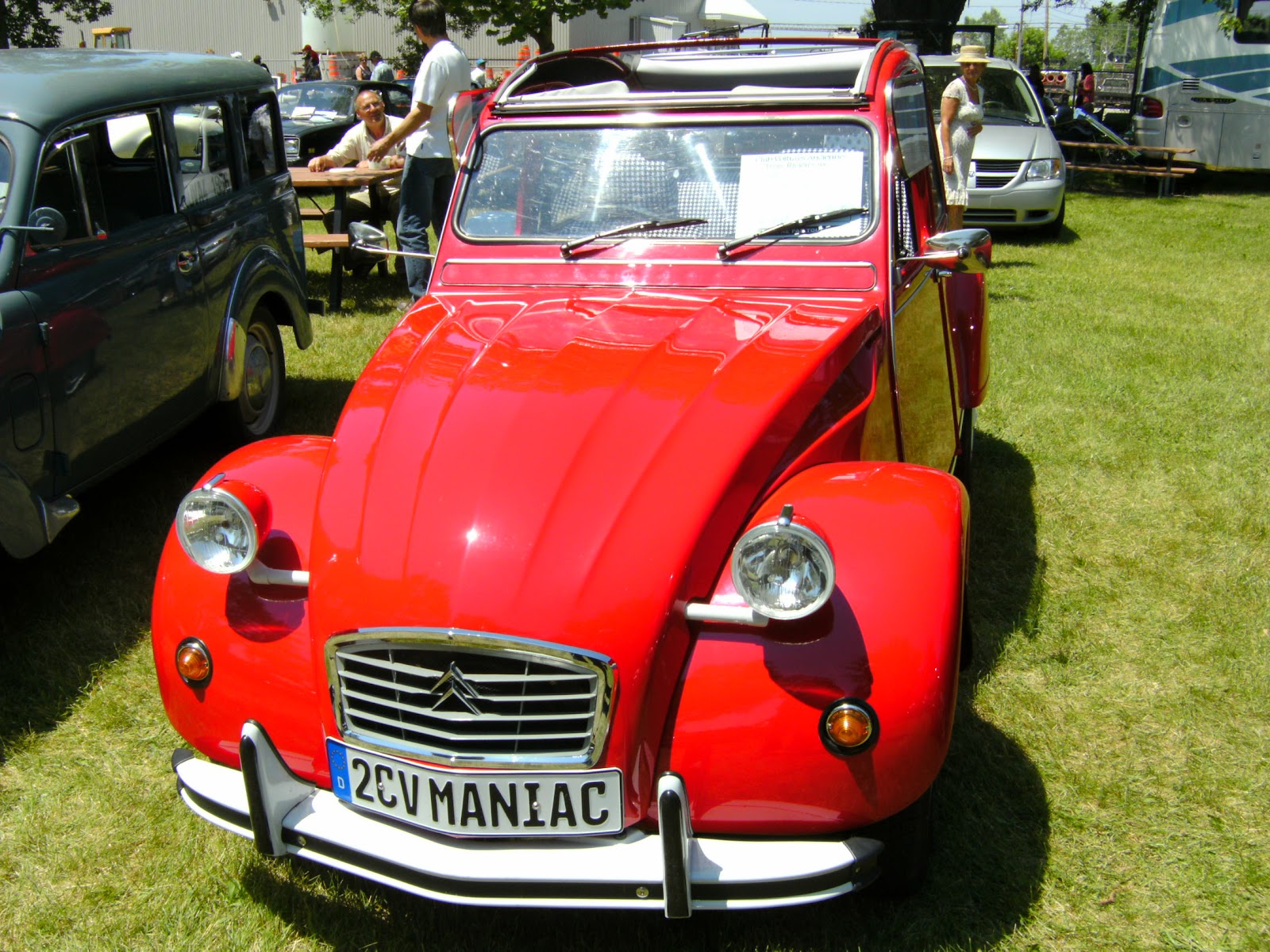
1986 Citroen 2CV

The "2CV" stands for deux chevaux,  i.e. “deux chevaux-vapeur [fiscaux]”, literally “two tax horsepower”
Bootlegger, modified


My mate, checking out the interior of a Corvette


The local L'Hebdo Journal wrote there'd be between 400 and 600 cars dating from 1903 to today, on exhibit yesterday at parc Pie XII.  (This park was named after the 12th of the popes named Pius).  There were nowhere near that many cars.  A handfull of kiosks (they foretold there'd be 50) sold hats and T-shirts and ice cream cones as retro music blared out from a loudspeaker.  Not much of a crowd (they predicted 10,000).  But today was Father's Day, it was beastly hot outside, and dozens of other activities were likely going on at the same time.  It was still interesting, and worth going to.  I know little about cars, or engines,  who made what model vehicle when, etc., but it's fun seeing these old relics, observing the enthusiasm and hearing the stories of those that do.

Some of these babies never get taken out (except for these expos).  Highly insured, they sit much of their life in protective garages, lovingly worked on, maintained, and bragged about.  When you see them on the highway, it's like going back in time.  Once we were driving home from Montreal when halfway up Route 40 all of a sudden, out of nowhere, come 50 Mustangs speeding past, all in a row,  all heading in the same direction.  Red ones, blue ones, orange ones, silver ones, old ones, new ones, original and "modified", their drivers in funky hats, grinning from ear to ear.  "Must be the Expo", we said. 

Well, anyway, that was our afternoon walk through the park yesterday. If anyone can tell me the exact year of the car in the 30th photo--the 1960's era Corvette, I will correct the label underneath the image. The owner was not on site, there was no identifying placard on the windshield, and no one we asked could say for sure. 

I have to say, my personal favorite was the flirty Beetle with the appended eyelashes, in Photo #41.

They all had distinctive personalities, a reflection--in many cases--of their caring and creative owners.  Several were for sale.  Those cars were really built back then.  I would love to have found the one from 1903, mentioned by L'Hebdo, but alas, we became undone, finally, by the heat and humidity and had other errands to attend to.  But what an interesting tour, among these driving machines of yesteryear, the now dated, ever 'cool', and occasionally, downright comical.  (sorry, Edsel.)

Enjoyed the show, and in retrospect, was kind of glad in fact that the anticipated crowds did not materialize.  This was supposed to be a short post recounting a walk in some park. Unfortunately, I had to go and take pictures.  Anyway, thought this might be of interest to some readers.   Or for the mechanically inclined--a looksee at a Lamborghini engine.  :)  I, for one, would not turn down a ride in a Lamborghini ANY day!


Trivia Car Questions I Don't Know the Answer To:

1.  When did they stop making those running boards on cars?  You know, at the sides of the car underneath the door as a practical device to ease your way in?  Made sense back then, when cars sat higher up off the ground than they do today.   Wiki says running boards could also be used to stand on while the vehicle is moving (think 'gangsters chased by police or rival gangsters'). Originally designed for functional or aesthetic reasons (think 'fashion statement'), later discarded as unnecessary.  But what was the last year any car came equipped with traditional running boards?  My mate has no clue.  And wishes I would stop asking car questions, ha ha.

2.  Why'd they make the steering wheel thicker? 
What people liked about the thin ones:  "good, tight grip with forefinger and thumb" says one.
What they like about the revised, thicker ones:  "Good resting place for the thumbs", says another.  Plus it looks and feels more like a race car!  Option packages with certain cars today enable you to change radio stations or your CD music without lifting your hand off the steering wheel; you just press into its padding on some invisible button. (I"m sure there is special jargon for these elements, but not being a car person, I can't name them.)

 'Car-person'--by that I mean I don't really pay much attention to cars; they are not on my radar, so to speak.  I've avoided owning one for most of my life, relying for transportation on buses, my bike or my feet (or lifts from friends).  I am relieved not to have responsibility for a car.

3.  Let's talk speed limits.  According to Wikipedia, "The first maximum speed limit was the 10 mph (16 km/h) limit introduced in the United Kingdom in 1861."  (I had to look that up.)  And up until 2010,   in Abu Dhabi, the highest posted speed limit was 160 km/h (99 mph).  It must be frustrating having a car that'll do 130 mph or more but never be in a position to test it.

I should wrap this up.  But wanted to mention, my interest in these cars was more connected to their place in our culture than their date of manufacture, top speed, or location of engine.  They seem like mobile museum pieces, painstakingly restored/skillfully rebuilt, at sometimes enormous expense, to be moved from here to there for display purposes, or sold privately to collectors.

They've evolved, some of them, from enormous gas guzzlers to compact electric plug-ins but there's a kind of seeming uniformity re: car styles today (with few exceptions).  Again, just my observation.  Because looking out a car window on a thruway, at dozens of cars zooming by, I would be hard put to identify the year, make or model of even a fourth of them.   Minus the logo, label or some identifiable uniqueness (I hear car afficionados laughing here), they pretty much all look the same to me.  (My mate gives me one of those looks, ha ha).

Well, so these were a few of the cars on display out in Parc Pie-XII yesterday. a fine assortment of metal, chrome, and color they were.  Interesting to see what lasts, and what fades.  (When was the last time you saw a new mud-brown, pink, orange or neon-green car, for example?).  Red is always "in".  But they're still basically all a one-color design.  Artful departures from this template are relatively rare.  (Two-tone is not radical; I was thinking more along the lines of patterned images.  As with houses, certain color/design combinations just don't "go".  Red is okay for a car or barn; purple polka dots, on the other hand, is notably non-conformist and visually offensive to the majority.  But perhaps only because we've been conditioned to assign things "to their place", in the social order of things, as it were.   Just like you can't leave the house with one blue sock and one brown sock on, you can't paint your car in stripes of half-orange/half black.  (Everyone knows those are Halloween colors!)

No, but seriously, onlookers will oooh and ahhhh at a Model T clunking down the path, try maybe to imagine what it would be like to ride in one; but when the Edsel appears--a ripple of laughter emerges.  Why?  (I speak for myself here.)  Why am I fascinated with Model T's -- and snickering at the Edsel?  An automatic, involuntary gesture, but it tells me I make value judgments based on perceived meanings, having less to do with aesthetics and more to do with what I think these particular cars "say" to me.  Let's put it this way:  If they somehow were to magically transform themselves from innert hunks of steel into knowable humans, which one would I feel more comfortable being around?    The model T, as clunky and basic as it seems, strikes me as ... well ... gentlemanly (if a bit mothbally)--while the Edsel ... reminds me for some reason, of Rodney "I don't get no respect!" Dangerfield, ha ha..  (Apologies, Rodney).

Okay, I'm done.  This is turning into a book. Went to a car show and I come away thinking about comparative personalities. 

A petite disclaimer.  I hate the color Yellow.  I think that color should be restricted to pineapples and bananas and sunflowers, not clothing and cars.  I don't own a single thing that is yellow.  Except maybe a pencil.  I also am not crazy about the color orange ("Halloween!"),  but I found myself pausing in front of that little yellow and orange 1938 Chevy 'Master' and its hand painted, half checkerboard/half red, twirly 'mouthed' design on its door.  Kind of like a school of odd-shaped, eyeless fish silently barking to whoever follows behind:  "Take note, folks.  We're going somewhere!"  And for that brief moment, I honestly would have given up a ride in the Lamborghini--and hopped in that little Chevy instead.   (This is what I meant by cars "speaking to you", drawing you in when you're hurriedly heading elsewhere, pulling you back, hinting "Hey look at me. Take a second look.  I'm not what I seem.  I'm more."

And so he was.  Things appeal to people for different reasons.  I'd deemed the VW "cute", and  labeled it my favorite (of this group).  I'm adding the '38 Chevy Master, despite its yellow/orange exterior, because it made me stop and really see it.

Car culture!!!  Yeah!!!