trip to the mountains
it's time
been 2 years already
Wednesday, July 27, 2011

Saturday, July 23, 2011
Heat wave

smothering heat humidity scorched grass
burning sun total fatigue brain mush
this is an image from a square kitchen plate I
got at a discount store it's above the sink so that when I do
dishes I don't have to look at the wall this is not a poem it's just
that seering fiery digital redness parallels the effect of heat today
i close my eyes and dream of
snow
Tuesday, July 19, 2011
Basket of Poems
* * *
* *
* *
* *
* *
Bill Knott ****** Ed Baker
Paul Pines ** Art Durkee
robert d. wilson
Don Wentworth
Alexei Tsvetkov
Juan Gelman
Tom Montag
Today! Over at Salamander Cove.
Million, billion, trillion, kazillion disconnect
29 companies had more cash than the U.S. government as of July 13

[Source: Think Progress.]
In the first half of July alone, Treasury cash balances were depleted from $130 billion to just $39 billion.[1]
Lost and Reported Stolen - $6.6 billion of U.S. taxpayers' money earmarked for Iraq reconstruction, reported on June 14, 2011 by Special inspector general for Iraq reconstruction Stuart Bowen who called it "the largest theft of funds in national history." [2] Last known holder of the $6.6 billion lost: the U.S. government.
U.S. Annual Air-Conditioning Cost in Iraq and Afghanistan - $20.2 billion [3]
Spent on Iraq War FY 2003 - FY 2010 = $801.9 billion.[4]
2012 Budget Request & Mandatory Spending re: Department of Defense: $707.5 Billion[5]
The total dollar cost of the wars in Iraq and Afghanistan so far exceeds $1.171 trillion.
All told, U.S. military spending in 2011 will exceed $700 billion — the most since World War II. That amounts to more than half of all government discretionary spending. It represents 35% of total military spending on the planet.[6]
A billion here
a trillion there
(. . . got some food


Friday, July 8, 2011
Ants and Spiders and poems and Life
Saw on Ron Silliman's blog yesterday a reference to a review of Don Wentworth's recently published book Past All Traps, Wentworth's first published collection of poems. The article's mention of Wentworth's "spiders yes, ants no" behavior made me smile. Because I do the exact same thing--rescue spiders and gently transport them outdoors, but stomp on ants.
I sometimes feel guilty about this because I'm generally with Buddha on the "no harm to sentient beings" thing. But here's the thing: It is what it is. And that's what the below-quoted poem addresses (without being explicit) re: our conscious attempts to be who we think we should be, only to be reminded that we are, after all, only human:
Wentworth continues to find those moments that describe a brief truth of our existence -- whether we like it or not.
Past all traps / my shame revealed -- / September ant.
"I capture spiders and take them outdoors," says Wentworth. "But ants? I'm setting traps. And that's part of who we are, too. This isn't all about being good. It's about being."
Carl Mayfield wrote that what drew him to this book "is the poet's incredible ability to pay very close attention to his discoveries, yet not say anything." [1] But this poet's words say a lot--the words don't merely present an idea/scene/emotion, they invite you to experience it up close (or remind you that you already have and elicit a sudden wave of understanding that has formerly eluded you).
Don Wentworth is resident in chief over at Issa's Untidy Hut, the poetry blog for Lilliput Review.. You can order his new book there.
I sometimes feel guilty about this because I'm generally with Buddha on the "no harm to sentient beings" thing. But here's the thing: It is what it is. And that's what the below-quoted poem addresses (without being explicit) re: our conscious attempts to be who we think we should be, only to be reminded that we are, after all, only human:
Wentworth continues to find those moments that describe a brief truth of our existence -- whether we like it or not.
Past all traps / my shame revealed -- / September ant.
"I capture spiders and take them outdoors," says Wentworth. "But ants? I'm setting traps. And that's part of who we are, too. This isn't all about being good. It's about being."
Carl Mayfield wrote that what drew him to this book "is the poet's incredible ability to pay very close attention to his discoveries, yet not say anything." [1] But this poet's words say a lot--the words don't merely present an idea/scene/emotion, they invite you to experience it up close (or remind you that you already have and elicit a sudden wave of understanding that has formerly eluded you).
Don Wentworth is resident in chief over at Issa's Untidy Hut, the poetry blog for Lilliput Review.. You can order his new book there.
Wednesday, June 29, 2011
Desktop Travelers
They say you should be careful what you wish for. A while back I expressed a silent plea to the universe to send me more work--not the tedious, mind-numbing data input kind but something I actually enjoy--like transcription work. A few weeks ago a client found a box of old cassette tapes of conferences from 30 and 40 years ago, converted them to CDs and has been sending them, small batches at a time, ever since.
Today a new client queried about my doing a lengthy, two-part interview, to be transmitted by a DSS file. And so I'm spending a lot of time at the computer listening to voices and keyboarding speeches, dialogues, anecdotes, historical reports, ruminations, etc. It's a mezmerizing world, where time passes so quickly: one minute you sit down with a morning cup of coffee, to begin; next thing you know it's supper time and you've somehow missed lunch. I have to remind myself to go outside and, as they say here, "take the air". Get some sun. Walk or bike the stiffness off.
In the meantime, I've been doing a bit of traveling--vicariously, that is. Yesterday I was at the beach. It was deserted and the sky and water and sand were just right. I have no idea where it was. I downloaded its image from the Google Images page and set it as my monitor's "wallpaper".
Today I'm in the little town of Llandudno in North Wales. I'm changing my visual wallpaper every week or so now. I have always wanted to go to Wales. This is probably the only way I will ever be able to do so, seeing as how even wild horses couldn't drag me onto an airplane, nor could I afford the ticket. I thank whoever it was who gave me the gift of unrelenting imagination, though. That you can look at a digital image and mentally put yourself there, be in the scene, not just observing the landscape but imagine feeling the brisk air, warmth of the sun, hear the sound of the rainfall on a tin roof, people talking in a language I can't understand. That you can go anywhere, into the past, even.
This happens also, from reading words in a book, or pulling some cherished memory out of the place it's stored in your head, and re-living it. What I find amazing is that it's sometimes so vivid, you almost don't want to 'come back.'
Meanwhile, back to the grind, so to speak. Voices from the machine are calling. Keystrokes to go before I sleep (apologies to Frost).
Today a new client queried about my doing a lengthy, two-part interview, to be transmitted by a DSS file. And so I'm spending a lot of time at the computer listening to voices and keyboarding speeches, dialogues, anecdotes, historical reports, ruminations, etc. It's a mezmerizing world, where time passes so quickly: one minute you sit down with a morning cup of coffee, to begin; next thing you know it's supper time and you've somehow missed lunch. I have to remind myself to go outside and, as they say here, "take the air". Get some sun. Walk or bike the stiffness off.
In the meantime, I've been doing a bit of traveling--vicariously, that is. Yesterday I was at the beach. It was deserted and the sky and water and sand were just right. I have no idea where it was. I downloaded its image from the Google Images page and set it as my monitor's "wallpaper".
Today I'm in the little town of Llandudno in North Wales. I'm changing my visual wallpaper every week or so now. I have always wanted to go to Wales. This is probably the only way I will ever be able to do so, seeing as how even wild horses couldn't drag me onto an airplane, nor could I afford the ticket. I thank whoever it was who gave me the gift of unrelenting imagination, though. That you can look at a digital image and mentally put yourself there, be in the scene, not just observing the landscape but imagine feeling the brisk air, warmth of the sun, hear the sound of the rainfall on a tin roof, people talking in a language I can't understand. That you can go anywhere, into the past, even.
This happens also, from reading words in a book, or pulling some cherished memory out of the place it's stored in your head, and re-living it. What I find amazing is that it's sometimes so vivid, you almost don't want to 'come back.'
Meanwhile, back to the grind, so to speak. Voices from the machine are calling. Keystrokes to go before I sleep (apologies to Frost).
Saturday, June 25, 2011
Reconciliation before Annihilation
The Big Snit (1985) written and directed by Richard Condie and produced by the National Film Board of Canada.
From the wonderfully wacky imagination of Winnipeg animator Richard Condie comes this tale of two simultaneous conflicts – the macrocosm of global nuclear war and the microcosm of a domestic quarrel – and how each is resolved.
The Big Snit won seventeen international awards, including the Grand Prize at the Montreal World Film Festival and a Genie Award for Animated Short Film. It was also nominated for an Academy Award® for Best Animated Short. [1]
Monday, June 20, 2011
Yesterday, out walking
Half sun-half cloud day, we decided to take a walk
down by the waterfront.
down by the waterfront.

I had seen this sign outside the library downtown Friday night. Which is why we went yesterday - to check out the Festival de Contes et Légendes Traditionnel, a 3-day event celebrating the tradition of oral storytelling. [Those panels in the distance behind are part of an outdoor art exhibit in front of the library, titled "Code 7".]

This painting was on one of the panels,
by Québec artist Fontaine Leriche

In the lobby of the entrance to the library,
suspended from the ceiling by near-invisible wires,
dozens of dancing stones
[click to enlarge]

A short walk down Boulevard de Forges
and you're at the Parc Portuaire.
Come on in, he says.

Making a carpet, the old-fashioned way, by hand.

Along the side (not in the picture), a row of animal skins
amid authentic artifacts from periods long past.
Sunglasses a modern addition to the costume.

How to hang a skin

Baking bread in an ancient (by today's standards) oven

What's a festival without cookies!

"I recommend these."

No, this is not a mini guillotine.
It's a kind of public stockade. This gentleman opted to try it out.
It's a kind of public stockade. This gentleman opted to try it out.

As did this one, except I saw his wife walking away, laughing.
You can't, of course, get out of this thing by yourself.
I think she came back. But not right away. :)

His little rug finished, he's now sculpting an axe handle.

Charlatans, vagabonds, and sinners alike,
a place just for them.

This transported portable 'confessional' (minus the priest) was next to a coffin being tended by this fellow, who said his name was "Baptist" (followed by four other family names I can no longer remember). I asked him to pose inside the box, if he would be so kind, and he responded with an actor's flair, promptly kneeling, staff in hand (it was actually a broom), exhibiting an air of feigned remorse (and not a little pretended fright -- at what penance the invisible priest might dole out). But these confession boxes are hardly a relic of the past. They still exist.

A storyteller, spinning a tale.

She brought her drum to accompany her stories.

Going back out the way we'd come in,
exiting the entrance.
(like 'up-the-down-staircase' people. :)
exiting the entrance.
(like 'up-the-down-staircase' people. :)

At the far end of the dock

Dinner-cruisers on the St. Lawrence

On the way back to the car we spotted a new (to us) restaurant (formerly a church) called Le Sachristain. It was closed. We stopped to have a peak at the menu. They have a combo soup/salad/sandwich called "The Trinity." Very reasonable prices. They even share their recipes (on their blog, such as for Spanish tortilla tapas and the "perfect" rhubarb pie. Inside was a cosey dining room, a book-filled bookcase to the side by the window. Have made a mental note to return, when it's open.

Near the big central post office, where we parked --
this statue. I snapped the picture before I realized there's
something stuck to the soldier's gun.
this statue. I snapped the picture before I realized there's
something stuck to the soldier's gun.


Heading home . . .
another statue

I don't know why but when I passed this alleyway, it drew my attention. It wasn't the building, it was the 'scene': that brilliant patch of sky juxtaposed between the the wall of windows looking down on a rather drab, concrete passageway. Apart from the dancing stones at the library, I like this photo best.
Anyway, that was our Sunday afternoon at the port. If you want to experience an aerial passover of the port (to the music of Bach), check out the video below.
(And this (below) is what it's like in the winter: Mentally hang-glide along (without wind or frostbite!) as you 'fly over' looking down:
In winter you can go ice skating there [see the skate path, at 2:03], as the long walkway is frozen smooth, traffic-free, prepared specifically for that very purpose. Even at the coldest, bleakest part of the year, people regularly go and walk here, or sit on a bench and watch the ships come and go, the ice floes floating by, the skaters skating.
Anyway, that was our Sunday afternoon at the port. If you want to experience an aerial passover of the port (to the music of Bach), check out the video below.
In winter you can go ice skating there [see the skate path, at 2:03], as the long walkway is frozen smooth, traffic-free, prepared specifically for that very purpose. Even at the coldest, bleakest part of the year, people regularly go and walk here, or sit on a bench and watch the ships come and go, the ice floes floating by, the skaters skating.
It's a wonderful place, just you and the seagulls, the fresh air, the river. I don't know, there's something about big rivers, and silence, and the 'air' of the north . . . The way some people go on and on about hot sunny beaches or climbing to the top of a mountain or taking the highway on their motorcycle--we all have our favorite things. This place, in the quiet early morning hours especially, is one of mine.
Sunday, June 19, 2011
Fathers and Sons (and Daughters)
This was recorded a long, long while ago. Yusuf Islam
[formerly Cat Stevens] is a grandfather now himself.
[formerly Cat Stevens] is a grandfather now himself.

To my Dad:
Thanks, too late to let you know.
Know that I understand now
and those traits you've passed on to me,
they've stood me well.
To my son:
Happy First Father's Day!!!!!!!
To my little grandsons:
Be who you are -- and pass on the love,
if and when you get to be fathers someday.
To all fathers everywhere, past, present, soon-to-be and future ones; stepdads, adoptive fathers, foster fathers and temporary fathers:
Happy Dad's Day!
New poems up today on Salamander Cove, for, on, by, and about "Fathers".
Thursday, June 16, 2011
Fun with Harmony #6

Ghost Faces, running out of space
[click to enlarge]
Goofing off again with Mr. Doob's Harmony Drawing Program.
Challenging, yes. It's hard to draw with a mouse. Noses come out deformed, color leaps from hair to face. You can't erase your mistakes: a chin gone wrong becomes a scarf. Art this is not--but it's fun . . . and relaxing.
It started out to be James Dean (but looks more like a bad attempt at a Dean Martin caricature). His shoulders seemed off a bit--so I made them into the hair of two girls. That gave me the idea to make it into a bunch of faces. The ones in the front could all be watching a movie. Hanky-panky going on in the back seat to the left, a conversation at the right, a mercenary keeping guard at the rear. The poor frightened girl with what looks like a beard--it's not a beard. Three tries at attempting a chin and I gave up and gave her a brown veil instead. Her hair is supposed to be yellow. (You call this yellow, Mr. Doob?!) If that's what yellow comes out like, what must flesh-colored (for the faces) look like? (You don't want to know.)
Challenging, yes. It's hard to draw with a mouse. Noses come out deformed, color leaps from hair to face. You can't erase your mistakes: a chin gone wrong becomes a scarf. Art this is not--but it's fun . . . and relaxing.
It started out to be James Dean (but looks more like a bad attempt at a Dean Martin caricature). His shoulders seemed off a bit--so I made them into the hair of two girls. That gave me the idea to make it into a bunch of faces. The ones in the front could all be watching a movie. Hanky-panky going on in the back seat to the left, a conversation at the right, a mercenary keeping guard at the rear. The poor frightened girl with what looks like a beard--it's not a beard. Three tries at attempting a chin and I gave up and gave her a brown veil instead. Her hair is supposed to be yellow. (You call this yellow, Mr. Doob?!) If that's what yellow comes out like, what must flesh-colored (for the faces) look like? (You don't want to know.)
The faces are too white. They look ghastly. Ghostly. So I'm calling this Ghost Faces.
No more mail
Canada Post is in lockdown. Mail service has been suspended nationwide, after 12 days of rotating strikes from Canada Postal Union Workers. In response, Canada Post has shut the system down.
--All post offices staffed by CUPW members are closed.
--All mail processing plants and letter carrier depots are closed.
--Mailboxes have been sealed to prevent mail from being deposited.
--Mail Delivery is suspended.
--Effective immediately, all service guarantees are suspended.
--Canada Post cannot predict how long the current situation will last.
I'm trying to imagine a future without libraries, bookstores, and now, house-to-house mail delivery. Doctors used to visit patients at home. Now you have to make an appointment, in advance, and you have to go to them. They won't come to you.
Imagine no more home mail delivery where everyone is forced to rent a metal box in some big building downtown where you have to go every day just to get your mail. Email is making personal correspondence by letter ("Who does *that* anymore!?") obsolete. Some people complain they get 300 emails a day. You can't just delete junk mail delivered to your door, though. More fodder for the recycle bin. What a waste of a tree's life.
I miss getting mail, though. And I guess I can forget about sending out those packages already taped and ready to ship out. Wonder where they're storing all the mail till someone gives the go-ahead to go ahead and start delivering it again. I pity our poor mailman. He will need a bigger carry-bag. A little wagon, maybe.
Please--just don't lock down the Internet yet. I can't imagine being communicationless for a week. But with LulzSec, Stuxnet and Anonymous all creating havoc everywhere else in cyberdom, who knows what might happen next.
Meanwhile . . . the nation waits. Our mail is . . . somewhere.
Impasse.
--All post offices staffed by CUPW members are closed.
--All mail processing plants and letter carrier depots are closed.
--Mailboxes have been sealed to prevent mail from being deposited.
--Mail Delivery is suspended.
--Effective immediately, all service guarantees are suspended.
--Canada Post cannot predict how long the current situation will last.
I'm trying to imagine a future without libraries, bookstores, and now, house-to-house mail delivery. Doctors used to visit patients at home. Now you have to make an appointment, in advance, and you have to go to them. They won't come to you.
Imagine no more home mail delivery where everyone is forced to rent a metal box in some big building downtown where you have to go every day just to get your mail. Email is making personal correspondence by letter ("Who does *that* anymore!?") obsolete. Some people complain they get 300 emails a day. You can't just delete junk mail delivered to your door, though. More fodder for the recycle bin. What a waste of a tree's life.
I miss getting mail, though. And I guess I can forget about sending out those packages already taped and ready to ship out. Wonder where they're storing all the mail till someone gives the go-ahead to go ahead and start delivering it again. I pity our poor mailman. He will need a bigger carry-bag. A little wagon, maybe.
Please--just don't lock down the Internet yet. I can't imagine being communicationless for a week. But with LulzSec, Stuxnet and Anonymous all creating havoc everywhere else in cyberdom, who knows what might happen next.
Meanwhile . . . the nation waits. Our mail is . . . somewhere.
Impasse.
Saturday, June 4, 2011
The Power of Persuasion

When my kids were growing up we had two little dogs named Harry and Zoe. They went for their grooming to The Barking Lot--or should I say The Barking Lot came to them. Although this name has apparently also been chosen for various dog-grooming services across the U.S. and Canada, this particular mobile pet-grooming van, equipped with a tub and all the fixings, was local and would arrive at our door and park outside the house. The owner, Jimmy, was very good with animals and he had what they call 'the gift of gab', talking as he worked, before, after and during. He recounted a story that today still stays with me, as an inspiration for those times when you may need to--but are unable to--persuade someone of something.
Jimmy was a busy guy--besides running his own little mobile pet-grooming business he worked with the local SPCA to try to find new owners for the more 'unadoptable' dogs--dogs nobody seemed interested in taking home with them: older, fatter mutts, handicapped or with an offputting personality. He appeared, once a week, on a local TV channel with one of these desperate-to-be-adopted creatures and gave his sales pitch. By the following week someone would have usually called in to adopt the animal.
There was one little dog, however, whom nobody seemed to want. Try as he might, Jimmy couldn't convince anyone to take her. I don't remember the breed but it was a small, yappy type that wasn't particularly cuddly. By the third week, not a taker in sight, the director of the TV program called Jimmy into her office. "You need to start showing another dog," she told him.
Jimmy was devastated. They keeps dogs in the pound only so long, and if they're not adoptable ... Animal shelters shelter an animal, they can't become their permanent home. The little dog's space there was needed for one of the constantly arriving new abandoned, mistreated, rescued or 'donated' animals found or formerly owned. Jimmy was at his wit's end. He tried everything he could to find her a home.
They had reached an impasse. Jimmy wasn't willing to just give up on the poor critter. He looked at the director, noticed her wavy, well-coiffeured, chestnut-colored hair. It was not a color one saw often on a woman her age when the strands of white begin multiplying exponentially. He looked back at the dog, then back at the director, and it came to him.
"You know," he said, "you two have exactly the same color hair!!!"
It was true. The hair on the dog and the hair on top the woman's head were an exact match. The director stared at the dog. "You're right," she laughed.
I don't know what Jimmy said to her to convince her that she should be the one to adopt the dog. Perhaps their personalities matched as well, hers and the dog's, and there was a moment of recognition there. Perhaps she sympathized with Jimmy's plight and made this magnanimous gesture out of respect for what he was trying to do and in support of the program. Who knows. But she ended up agreeing to take the dog.
Jimmy had the dream to one day start a program to train inner-city youth to become dog groomers like himself. It was a thriving business and there weren't a lot of mobile pet-grooming outfits around, which would give them an advantage. He tried to get funding for such an enterprise. I don't know if he was ever able to persuade the dispensers of state grants to support this endeavor, as this was a long, long time ago, but I like to think it eventually happened.
One often hears that phrase, "the power of persuasion". Marketers sometimes focus on your perceived benefits from buying a certain product. But what benefit would a yappy dog with a difficult personality be to anyone, regardless of its having the same color hair as you? I don't think "power" was the element at play here. Nor simply resonance ("That animal and I share a common feature" , whether hair color or personality). Maybe it was the gift of empathy (as in, not everyone is born with it; when not 'learned', just automatically "having" it, is a gift).
I've seen this before. Someone resolutely, absolutely feels strongly about a certain thing: they hate dancing, they don't care for opera, they don't drink tea, they don't like children, for example. And then something happens to make them change their mind, that allows them to see a thing from a different perspective, so to speak. "Children in general are noisy, energetic, demanding little humans but THIS one, this one child might prove the exception; all operas suck, just a bunch of fat women screeching on a stage, but this one aria, absolutely transfixes me, gives me goosebumps it's so beautiful; even if I have wooden feet and can't dance if my life depended on it, I would try, even pretend, for my beloved; decaffeinated green tea's supposedly healthier than coffee, maybe I could learn to switch..."--are all examples of little moments that whisper: take another look-see, allow another perspective in, another way to look at a thing.
Maybe the one person who could make that chestnut-haired dog toe the line, so to speak, would have been the director. I got the impression from Jimmy that it was a success story. What was it that ultimately did the trick, I wonder--to get her to actually agree to adopt the contentious little dog? Was it really his "power of persuasion"? Or her sense of humor and empathy that finally sealed the deal?
Some things are harder to persuade people about, even coming from themselves.. They'd like to do something, but can't (they say). Quitting smoking or drinking, for example. Physiological (and behavioral) addictions are harder to overcome, as is, sometimes, irrational thinking. You acknowledge the benefit of something but are unable, for whatever reason, to do what's necessary to achieve it. Why does that phrase "Do what I say, not what I do" pop into my head right now, ha ha (recalling nurses or medical practitioners I have known who tell you to do (or not do) something related to your health, advice which they themselves totally ignore).
Anyway, back to Jimmy at The Barking Lot and unadoptable animals, and people who are somehow persuaded to suddenly do something totally out of character for them (like the director), which may ultimately change their lives. Penetrating the perceived rigidity of a mindset, where light can still get through. This little 'Jimmy story' for me echoes another oft-repeated saying from an old friend from many years ago, that reminds me that even in the most depressing or horrific of circumstances that keeping the mind open to other perceptions/possibilities will be the ticket out of it. "You never know", he would always smile and say. (The equivalent, to me, of "Never give up.") You "never know" unless you try. You never know what you are capable of when you allow yourself to step out of the box of set-in-stone thinking.
I myself would not have taken that dog. I knew a "difficult" dog once. Not only difficult but vicious. Her name was "Princess" and she lived a few blocks from me then. She would come out of nowhere and chase after and bite at the ankles of passersby, growling and nipping and tearing at their trouser cuffs. I was absolutely terrified of that little dog. I tried to think of how I might persuade someone, were the situation reversed and Princess was the dog poor Jimmy had to find a home for, how I might convince someone to take her. I come up with a complete blank. I wouldn't wish this dog on my worst enemy, as the saying goes. So maybe there's more at play here than persuasion and openness: those sometimes impossible situations for which there is no answer.
In the film "The Unbearable Lightness of Being" there's a scene in traffic where a car passes by of which its occupants, a woman and her dog, resemble one another. Apparently it's not all that uncommon:

This random memory--the Jimmy-of-The-Barking-Lot story--arrived in my head upon waking this morning--I have no idea where it came from, or why--along with the word "persuasion", compelling me to wonder what it is I might be trying to persuade myself of, ha ha. Or maybe it's me telling me to hang in there, there is a way out of this or that particular dilemma, I must not give up, because ... "You never know." It's funny how the words one hears, or believes, can form the basis of an 'outlook', a suggested way of being. And I find myself repeating that "You never know" expression, by way of encouragement, not only to self but others. (Perhaps the title of this posting should have been "The Power of Possibility".)
 There are four of my canine buddies now at the local SPCA in urgent need of adoption: Fantôme, Oupsy, Willow and Nutella. (That's Nutella over at the right.) Fantôme has been living at the shelter since January. Someone tied Willow to a tree and then abandoned him. He doesn't do well, being confined to a cage, continually trying to get out, sometimes injuring himself. Oupsy, loveable clutz, always getting tangled in her leash, is the most affectionate creature. She hadn't quite got the hang of ball-gets-thrown-you're-supposed-to-chase-after-it-not-just-stand-there-watching game, what a goof, but she's positively delightful; I can't imagine why no one's taken her yet. And poor old Nutella, placed on the "urgent adoption" list now as she's not tolerating "life in a cage" too well lately.
 I know, I know, getting emotionally involved with strange animals can sometimes be a curse. One can't save them all. Still ... they have so much to teach us, they're such great fun sometimes. Annoying, too but hey, so are humans. Today they're having a big garage-sale fundraiser at the SPCA where visitors can tour the premises and see what they do there, met the staff (and animals) and perhaps increase their awareness of how hard it is to take care of and try to place these unfortunate animals.
My jury's still out (about the reincarnation thing) but I wonder, if that were true, what would happen if I "came back" as a dog. ("Oh Lord, a St. Bernard, I mean really. I would have preferred being a Husky. Do you know how much it would cost someone to FEED me? And with all this hair--summers would be unbearable!") Assuming one had a choice in such things, ha ha. I think what, where and who you come back as is supposed to teach you a life lesson you didn't manage to learn the first time around, so maybe that'd be my karma--to be a St. Bernard and have to go save people lost in snowdrifts, to make up for all the times I maybe could have helped someone, and didn't. Who knows.
"You never know."
Wednesday, June 1, 2011
Gettin' Scary out there
"If you shut down our power grid, maybe we will put a missile down one of your smokestacks."
The US government is rewriting its military rule book to make cyber-attacks a possible act of war, giving commanders the option of launching retaliatory military strikes against hackers backed by hostile foreign powers.
The Pentagon has concluded that the laws of armed conflict can be widened to embrace cyberwarfare in order to allow the US to respond with the use of force against aggressive assaults on its computer and IT infrastructure.
The move, to be unveiled in a US department of defence strategy document next month, is a significant step towards the militarisation of cyberspace, with huge implications for international law.
[Source: The Guardian, May 31, 2011]
" ... except for a brief period between the fall of Saigon and the Iranian revolution, the United States has been engaged in constant warfare somewhere in the world since the attack on Pearl Harbor in 1941. That's seventy years of perpetual war that does not appear to be ending any time soon. At present the United States Military is engaged in ongoing armed conflicts in Afghanistan, Iraq, Korea, Yemen, Somalia, and Libya." [1]
The Pentagon has developed a list of cyber-weapons and -tools, including viruses that can sabotage an adversary’s critical networks, to streamline how the United States engages in computer warfare.
The classified list of capabilities has been in use for several months and has been approved by other agencies, including the CIA, said military officials who spoke on the condition of anonymity to describe a sensitive program. The list forms part of the Pentagon’s set of approved weapons or “fires” that can be employed against an enemy. [Source: The Washington Post, May 31, 2011]
The US government is rewriting its military rule book to make cyber-attacks a possible act of war, giving commanders the option of launching retaliatory military strikes against hackers backed by hostile foreign powers.
The Pentagon has concluded that the laws of armed conflict can be widened to embrace cyberwarfare in order to allow the US to respond with the use of force against aggressive assaults on its computer and IT infrastructure.
The move, to be unveiled in a US department of defence strategy document next month, is a significant step towards the militarisation of cyberspace, with huge implications for international law.
[Source: The Guardian, May 31, 2011]
" ... except for a brief period between the fall of Saigon and the Iranian revolution, the United States has been engaged in constant warfare somewhere in the world since the attack on Pearl Harbor in 1941. That's seventy years of perpetual war that does not appear to be ending any time soon. At present the United States Military is engaged in ongoing armed conflicts in Afghanistan, Iraq, Korea, Yemen, Somalia, and Libya." [1]
The classified list of capabilities has been in use for several months and has been approved by other agencies, including the CIA, said military officials who spoke on the condition of anonymity to describe a sensitive program. The list forms part of the Pentagon’s set of approved weapons or “fires” that can be employed against an enemy. [Source: The Washington Post, May 31, 2011]
Tuesday, May 31, 2011
Bats, Fish, Wearable Words & Recycled Duds
[click to enlarge]
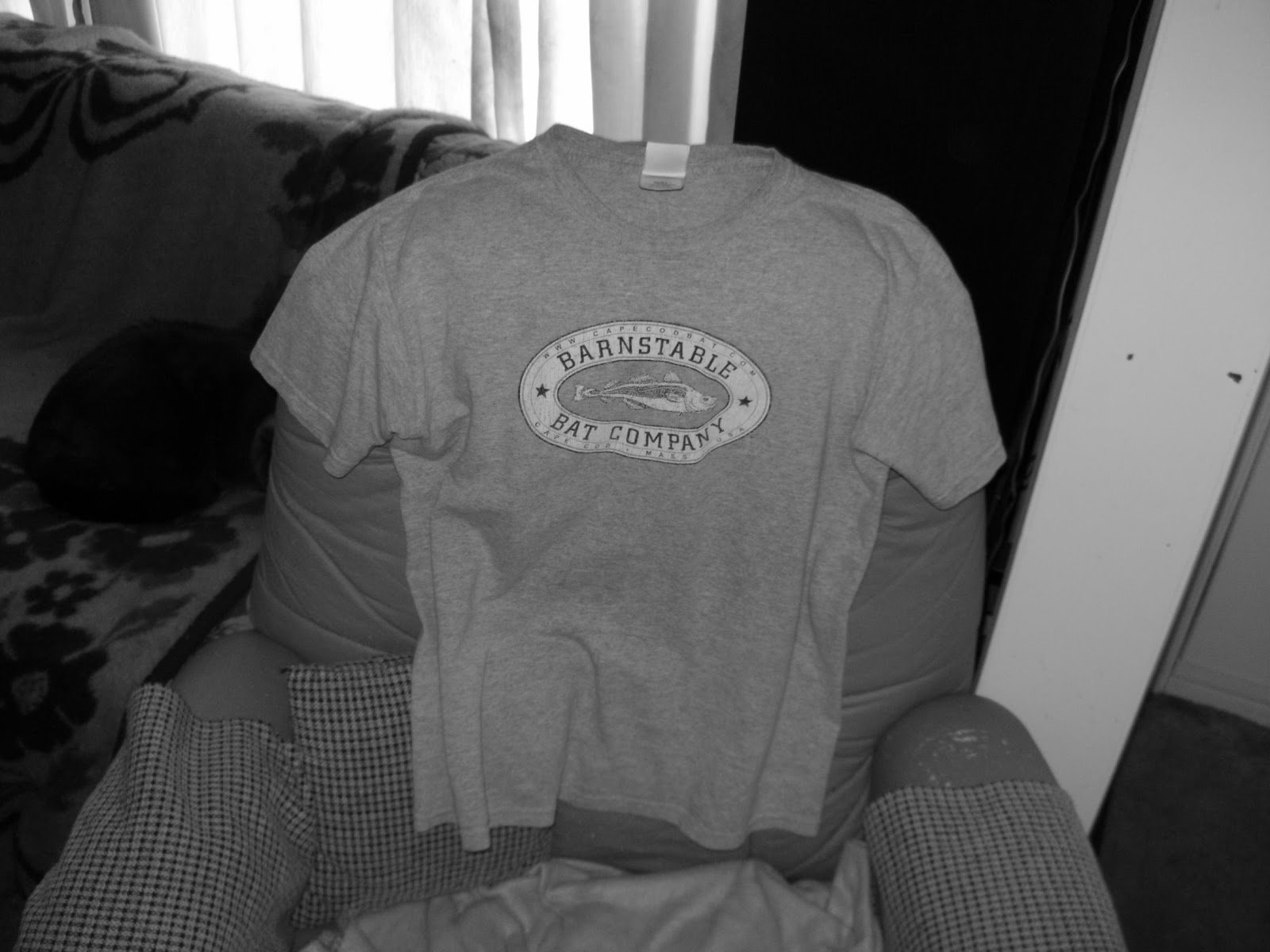
The last time I was down in the States, my daughter and I stopped by the Garment District in East Cambridge (Mass.), a funky clothing establishment where, on Fridays, you can get gently worn apparel at $1 a pound. I came back with this gray T-shirt from Barnstable Bat Company, which sports a codfish in its logo. The town of Barnstable (pronounced "BARN-stbbl"), is on Cape Cod, so that would explain the codfish--but the image that first popped into my head at the words "bat company" ... was of a large, winged bat. (My mate thought the logo indicated a fish market. We were both wrong. The company makes wooden baseball bats.)
I once inherited a T-shirt with the black dog on it. I say "the" black dog, because most everyone on the Cape would recognize it as the dog from the Black Dog Tavern, a Martha's Vineyard island icon, no need to add identifying words.
A couple of years ago it seemed a trend hereabouts to wear clothing covered with words from seam to seam, as part of the design. The words--from long quotations to strings of random phrases--could be in any language and they didn't have to make any sense. I saw one in Latin once, in Gothic script trailing up the sleeves from cuff to shoulder and continuing across the back; and one frilly top that contained nothing but action verbs.
Putting words and images on clothing as messages (or "art"), though, is nothing new. Words or symbols attached to or printed on items (not just clothing) that compels us, consciously or subconsciously, to buy, wear or use them, or as expressions of who we think we are.
Somewhere along the line, in looking to heighten brand-name identification, corporations must have noted the invisibility factor of labels sewn into the inside of a garment and decided to be more in-your-face about letting everyone know just whose product that piece of clothing you happen to be wearing, is. ("Let's put our name (or company logo) on the outside!" I can imagine them saying.) A marketer's dream: "Ah," someone notes unconsciously, encountering the worded garment being walked down the street, "she shops at [insert name of department store]." The wearer, in effect, has become a human billboard for that particular clothing corporation.
Then came the T-shirt phenomenon, where words and symbols exploded as messages of hope ("Yes We Can!"), anger ("No More War!"), concern ("Save the Whale!", "Free Tibet", etc.), as a way of parading one's status, personal beliefs, academic or political affiliation, or attitude.
This propensity to wear the words and symbols with which we identify is not just limited to clothing. We also like stenciling them into our own bodies, by way of a tattoo needle. Unlike the branding of cattle--which for the animal is involuntary--the marking of one's own body as a wearable word or symbol is an example of, I think, the all-too-human desire to "say" something about ourselves, to express something that's inside (by wearing it on the outside).
They're so pervasive nowadays, these worded garments, though, that people barely notice anymore. Nor does anyone necessarily know or even care what they mean, these mass-produced words or symbols copied, spread, worn--as "decoration". (I'm pretending I'm an alien from another planet, looking down on Planet Earth and wondering: "Why do they have this peculiar need to want to enhance everything--with text, or more color, or accessorization?" ha ha.)
I once was putting something away in my closet and noticed that practically everything in there was of a solid color (mainly Navy blue, black, or earth colors). Only the occasional delightful cobalt blue, vivid red, dreamy bluish-green, or soft lavender. I can't wear white or gray--the color immediately drains from my eyes with the former, and I look literally half dead with the latter. I never buy anything orange, kelly green, yellow, or pink, because they're not me. Stripes (depending in which direction, and rarely), plaid (never!), polka dots, kazillians of tiny little (or large, flashy) flowers (styles a bit on the too-"busy" side), or fabric that looks like a kitchen curtain were also not to be found in that closet And nothing with words on the front, back, pocket, hood, or sleeves. Does that make me a fashionista dinosaur, I wonder.
I do not spend a lot of money on clothing, and I recycle them frequently. Knowing where somebody's clothing comes from or having a preconceived notion about certain 'types' of clothing can heighten (or lower) one's perception of the wearer of that clothing. You see this in newspaper articles sometimes; for example, when the reporter finds it necessary to include a deatailed description of what the subject is wearing ("Mr. X, wearing a black leather jacket and chain lecklace"; Miss Y, dressed in a peasant-type skirt and black tights..."; Mr. Z, impeccably attired in a pin-striped suit and tie...", etc.), to imply something about the subject's character.
About clothing other than the 'store-bought' kind, it's not that you cant find well-fitting, quality-made or even originally outrageously expensive "brand-name" apparel at local thrift shops. You can, and I have. It's amusing though, some people would never dream of wearing a shirt or jacket formerly owned by some stranger (it must be new, straight from the manufacturer, unowned by anyone before). Wearing your dad's old hunting shirt or cousin Sally's former prom dress or an older sibling's hand-me-downs is okay, though, 'cuz they're "family.". Yes, says my imaginary alien, "You humans are certainly weird."
Yes, we are. Some of us, anyway. We come in many varieties. No one mold fits us all. And today nobody really considers the proliferation of words and symbols on the fabric in which we clothe ourselves as anything unusual. We do, however, have somewhat standard ideas about fashion, having to do with what goes with what and what doesn't. Wearing a short blue sock on one foot and a long purple sock on the other, for instance, is something no human would ever do, intentionally. Socks HAVE to match. That's just a given.
It might have something to do with the symmetricality of humans having two (matching) eyes, two (same-length) arms, two (pretty much identical) hands, legs, feet, etc. Cultural, regional or generational fashion proclivities aside, no one considers you weird for following your particular 'clan'. (They might find your clan strange but it's an acknowledged difference. You as an individual representing that clan or group fit into a knowable, identifiable category. A person deliberately going about wearing one short blue sock and one long purple sock, however, fits no easy category you can place him into. Does he fit the category of People-Who-Don't-Know-the-Rules? or the category of Somebody-Who-Doesn't-Know-Any-Better? Or maybe he's one of those People-Deliberately-Trying-to-Get-Attention type persons. The point is, wearing socks that don't match is something people notice. It calls attention to its being an anomaly. That's not the way the unspoken rule of fashion operates. Everybody knows socks have to match. It's a given.
Ditto for gender-based "rules". In most of the civilized world, men don't wear skirts. Scottish kilts, the robes worn by priests, etc, and the many-medalled military jackets of retired generals are a sort of costume put on for special occasions, not usually worn in everyday life. As are the outfits we wear in performing certain type employment such as medical, social, military, and security-related jobs. Even without identifying words, most people recognize the 'uniform.'
Like a culture's costumes hundreds or thousands of years ago, the type and style of clothing we wear is merely a reflection of who we were or are. Who knows in 50 or 100 years from now (if Planet Earth survives till then), what humans will be wearing. (Hopefully not those one-style-fits-all androgynous outfits worn by the crew of the Starship "Enterprise", samples of which I've seen go for over $2,000, as a "collectible".) ( I wonder if my Barnstable Codfish Bat T-shirt will one day be a collectible.)
For now, the codbat (as I've begun to think of it) functions as my garden shirt, upgraded from its former duty as a pajama top. I must not let those words (and that fish image) go to waste though. I must start wearing it out in public! Like to the supermarket, that when I approach the fish counter, might prompt a fellow shopper to inquire as to its meaning. (And then I can wax specific about the beaches of Cape Cod, how wonderful it is riding on a bike down some little road past those pretty cottages with flower boxed windows, the smell of the ocean air wafting past, the quiet lap of the waves, and . . .
"Really," says my fictional alien visitor, "you earth people are truly strange."
_______________________________
*Disclaimer. A person actually did go out the front door once having on one blue sock and one brown sock. Me. It was not intentional, however. This happened many years ago and I was shocked--shocked, I say--that I had not noticed. I immediately remedied the situation, of course, relieved that no one had seen. It was then the notion first came to me--this idea of the unspoken "rules" one accepts to live by, regarding choice, type and style, of wearing apparel. I was looking on the situation from the outside, as it were, and found the whole thing hilarious. What strange creatures we are, I remember thinking (meaning us, humans) (as if I wasn't human).
Hence the fictional alien above has some precedence. Color, style and texture are important in clothes. Words? I'm not so sure about the latter. If clothes define us (as many perceive they do), then clothes carrying words also say something about us. Or not. It's that aspect of the phenomenon that strikes me as most interesting, that words themselves, once confined merely to the printed page and directional/locational signifiers (buildings, roadways, rooms of education) escaped, as it were, and infiltrated our duds, so thoroughly, and so completely, that no one even notices anymore. It's just part of the scene.
But don't take my word for it. Try this little experiment. Wear a T-shirt with some words on it--any words--and go walk down the street. Note how many people actually LOOK at it, read what it says. Now go back home and put on one short (any color) sock, and one long (different color) sock and go sit somewhere at a bus stop, at the mall, in a waiting room or at a friend's house somewhere, where they can see your socks. Note the reactions. I'm just saying.
P.S. I'll probably recycle the 'codbat' come autumn. It cost $18 new. I got it at a Dollar-a-Pound for pennies. Who knows how old it is. I wonder who its next 'owner' will be and what its fate may eventually become: a cloth to wash the car with, maybe. Some orphanage in a third-world country. Cut up and shredded for scrap. Or hanging in a place of honor in some collector's closet, as a cherished Collectible. I wish for it the latter. No, wait. It should go to the orphanage, live a purposeful life, instead of just hanging there, taking up space. In the meantime, it lives with all my other duds, a true equal, albeit boasting somewhat of being an anomaly, being as it's the only one with (washable!!) words.
Speaking of words, ha ha. Good grief.
Saturday, May 28, 2011
Fun with Harmony #5

Red Drop, Dancing

War, Up Front and Personal


3as1
_______________________________________________________
*Experimenting again with Mr. Doob's Harmony Drawing Program
Poets, Prizes and Ponderings
How did I miss this announcement during National Poetry Month in April? A new poetry contest has emerged, intending to be "the world's largest poetry competition". The Montreal International Poetry Prize will not only award $50,000 for the best poem but publish the top 50 finalists in a "first-of-its-kind annual global poetry anthology."
The prize money was made possible anonymously, with the hope that this will become "an annual means of raising funds for promoting and supporting poetry around the world, including direct financial support for poets and the creation of a dynamic global poetry centre."
The ten international poets on the Editorial Board (which will change every year) will read the submissions and choose the 50 best poems for the anthology, which will be published in print and in e-formats by Montreal’s Véhicule Press in the autumn of 2011. They intend to eventually then publish the next best 100 of the poems submitted, in a second, separate anthology.
Final deadline is July 8, in case anyone is interested in sending in a previously unpublished poem. All entries will be selected and judged anonymously. The winner will be announced in December.

I like the 'direct-financial-support-for-poets' part of the equation. :) Imagine, being paid for writing poetry! Granted, there are a lot of poets who are paid to teach poetry (as their day job), which could be both a stimulus and a deterrent vis-a-vis one's own creative writing, but imagine just receiving a windfall, out of the blue, for poetry you've already written.
It must be nice to receive $50,000 for your poetry. One poet recently was awarded double that amount. David Ferry, 87, was "thunderstruck" to discover he was chosen as the 2011 recipient of the $100,000 Ruth Lilly Poetry Prize this spring. He accepted the honor of this organization's "recognition of an extraordinary lifetime accomplishment for a living U.S. poet"--but as to the prize money, he says: "I'm giving it all away." It will go to "various social-service organizations he has supported in the past." (Ferry, "who has volunteered for about 30 years at a Boston soup kitchen," says "It's like a great windfall," but believes that "a windfall should be used, if possible, not as if it were your income.") [1]
In an interview with Tess Taylor, Ferry describes how he first came to poetry, talks about translating poetry, about poetry that just "comes up", and the element of "happenstance":
"It’s all about happenstance, but then it also happens to connect up. The things that happen to you seem to happen by accident but, because you’re you, they seem to connect to other things."
The money prize is only one motivation for submitting one's poems to contests; the desire for recognition a significant part of it as well. What fascinates me (endlessly) are poets themselves, what they write, why they write, how they write, poets who translate other poets; but even more than that ... Poetry itself. As to financial recompense: "Do what you love and the money will follow" does not always follow. And recognition? How many poets' work is only discovered, accidentally, decades after they've left the earth. And the life of the poem itself: ones stand the test of time to become 'classics'; words in any poem that literally change your life.
Anyway ...
The prize money was made possible anonymously, with the hope that this will become "an annual means of raising funds for promoting and supporting poetry around the world, including direct financial support for poets and the creation of a dynamic global poetry centre."
The ten international poets on the Editorial Board (which will change every year) will read the submissions and choose the 50 best poems for the anthology, which will be published in print and in e-formats by Montreal’s Véhicule Press in the autumn of 2011. They intend to eventually then publish the next best 100 of the poems submitted, in a second, separate anthology.
Final deadline is July 8, in case anyone is interested in sending in a previously unpublished poem. All entries will be selected and judged anonymously. The winner will be announced in December.
I like the 'direct-financial-support-for-poets' part of the equation. :) Imagine, being paid for writing poetry! Granted, there are a lot of poets who are paid to teach poetry (as their day job), which could be both a stimulus and a deterrent vis-a-vis one's own creative writing, but imagine just receiving a windfall, out of the blue, for poetry you've already written.
It must be nice to receive $50,000 for your poetry. One poet recently was awarded double that amount. David Ferry, 87, was "thunderstruck" to discover he was chosen as the 2011 recipient of the $100,000 Ruth Lilly Poetry Prize this spring. He accepted the honor of this organization's "recognition of an extraordinary lifetime accomplishment for a living U.S. poet"--but as to the prize money, he says: "I'm giving it all away." It will go to "various social-service organizations he has supported in the past." (Ferry, "who has volunteered for about 30 years at a Boston soup kitchen," says "It's like a great windfall," but believes that "a windfall should be used, if possible, not as if it were your income.") [1]
In an interview with Tess Taylor, Ferry describes how he first came to poetry, talks about translating poetry, about poetry that just "comes up", and the element of "happenstance":
"It’s all about happenstance, but then it also happens to connect up. The things that happen to you seem to happen by accident but, because you’re you, they seem to connect to other things."
The money prize is only one motivation for submitting one's poems to contests; the desire for recognition a significant part of it as well. What fascinates me (endlessly) are poets themselves, what they write, why they write, how they write, poets who translate other poets; but even more than that ... Poetry itself. As to financial recompense: "Do what you love and the money will follow" does not always follow. And recognition? How many poets' work is only discovered, accidentally, decades after they've left the earth. And the life of the poem itself: ones stand the test of time to become 'classics'; words in any poem that literally change your life.
Anyway ...
Organizations and their prizes
poets and their writing and their poems
recognitions, obscurity, aspirations, generosity
the written word connecting . . .
all of a piece
a Saturday morning's
tiny musings
tiny musings
Sunday, May 15, 2011
They caught my eye

rainwater of a Sunday afternoon
brief shadow lands
before sky went dark

My garden buddha lost his arm.
(Like that's gonna deter him from slug patrol!)
The bees love him, land on his head.
Been with us five years now, refuses to retire.
Been with us five years now, refuses to retire.

Every spring, in the exact same spot
a single tulip
 Hallowed-out section of
a tree stump

a tree stump
Subscribe to:
Posts (Atom)